The Ascent
Own the Substrate — A Map to 2045

“The world is being repriced, rebuilt, and redrawn. Beneath it all is the Ascent.”
Preface
This is the paper I have wanted to write for a long time.
Most of what gets called analysis today is reaction. People watch a print, watch a chart, watch a headline, and try to extrapolate the next ninety days. That is not analysis, that is positioning.
What I am going to lay out here is a forecast for the road to 2045. The nearly two decades between now and then are going to compress more change into the human experience than any equivalent window in modern history. I say it because the math suggests it.
I am writing this as an investor. I am also writing it as someone who believes the most important thing a serious person can do right now is build a coherent picture of where this is going. Without that picture, everything looks like noise. With it, more of it looks like signal.
The thesis is simple. The implications are not.
We are living through what I am calling the Ascent: the simultaneous reorganization of every major system humans have built over the last five hundred years. Labor. Energy. Money. Empire. The boundary between Earth and space. The boundary between human cognition and machine cognition.
All of it is moving at once.
This is not the end of the world, but it is the end of a world. The next one is being built, in plain sight, by people who are not asking permission and are not waiting for consensus.
This paper is my attempt to map the structure of that next world, and to lay out the long-duration trades that follow from it.
Most pieces of this thesis exist elsewhere. AI labor displacement, the grid bottleneck, critical minerals, the space economy, defense modernization, dollar erosion, great-power competition. None of these are mine. What is mine is the integration and synthesis. The argument that all of these forces are stacked exponentials feeding the same transition, the framing of the National Security Stack as a single emerging entity, and the Redraw chapter on memetic warfare. The synthesis is the contribution.
I am writing this with conviction. The destination of this transition is, in my view, the most likely structural outcome. The most important debate is about pathing and speed. I should be clear that I started writing this paper already long the buildout. The reader should weigh the analysis with that bias visible rather than buried.
If you take only one thing away, take this: the people who reach 2045 in the right position will not be the ones who saw it coming. They will be the ones who acted while the rest were still arguing about whether it was real.
This paper is also the operating worldview behind my own investment practice. The mandate is straightforward: long-duration ownership of the substrate of what is emerging. The four frontiers are where the structural exposure lives: AI, robotics, energy, space, with defense as the envelope that runs across all of them. The job is to identify the bottlenecks, own the strategic assets, and hold through the volatility. Not to trade headlines.
The Core Claim
This paper is not the end of an argument. It is the source code for one.
The road to 2045 will shift wealth and power from those who sell labor or hold paper claims to those who own the infrastructure of automated production, energy abundance, and frontier expansion.
Human civilization is moving from a labor-constrained, energy-constrained, planet-bound economy into an intelligence-abundant, automation-heavy, energy-expanding, space-capable one. The transition will be volatile, politically destabilizing, and monetarily messy.
Compute, robotics, energy, launch costs, and synthetic biology are all inflecting at once. The curves feed each other. The buildout required to support them is one of the largest infrastructure cycles ever attempted. The grid, the supply chain, and the political system are not configured for it. Capital is flowing into the bottlenecks, and the companies and countries that own the means of automated production are going to capture a structural share of global output.
The Four Frontiers. AI. Robotics. Energy. Space. Defense is the envelope that runs across all four.
The Posture. Long-duration ownership, not short-term trading. Position for the decade. Hold through the drawdowns. Ignore the noise engineered to remove you from the position.
The analytical core of this paper covers the road to 2045. Some claims extend past that into what I call the mythic horizon. Those are not trades for today. They are the long arc the bottleneck decade makes possible.
First, I want you to feel the transition. Then I will give you the map.
Table of Contents
I. We Are Living Through It
II. The Comprehension Gap
III. The Repricing of Intelligence
IV. The Energy and Materials Reckoning
V. The Expansion Into Space
VI. The Erosion of Money
VII. After Unipolarity
VIII. The National Security Stack
IX. After Labor-Capitalism
X. The Coalition of Fear
XI. The Redraw of Reality
XII. The Ascent
XIII. The Bets
XIV. The Trade and the Hold
Signals to Watch
Selected Sources
Parting Thoughts
I. We Are Living Through It
You are not in a normal market cycle. You are not in a normal political cycle. You are not in a normal cultural cycle.
You are in a transition.
Transitions feel like collapse from the inside. That is the part nobody tells you. When you read about the Industrial Revolution in a textbook, it sounds clean. A diagram with arrows. Steam, then rail, then electricity. In real time, it was riots, panics, depressions, wars, displaced populations, broken families, and decades of confusion punctuated by sudden bursts of unrecognizable wealth. The people inside it had no idea what they were inside.
We have no idea what we are inside.
The shape of every major transition rhymes. The old systems do not die quickly. They centralize. They print money. They demand loyalty. They invent new enemies. They suppress the new thing as long as they can, and then, when they realize they cannot, they try to absorb it. Sometimes they succeed. Often they do not.
What is different this time is the speed. The Industrial Revolution unfolded over roughly a century and a half. The internet revolution unfolded over roughly thirty years. The current transition is going to unfold faster, because multiple curves are inflecting at the same moment. Compute. Algorithms. Robotics. Energy generation. Launch costs. Synthetic biology. Each one would be a generational shift on its own. They are arriving simultaneously, and they feed on each other.
This is what people miss when they argue about whether AI is overhyped. They are looking at one curve. The story is not one curve. The story is what happens when six curves intersect.
When you are inside an intersection like this, your job is not to be right about the next quarter. Your job is to position for the next decade and to stay grounded when the noise becomes deafening.
One thing the reader can verify without my help: look at where the talent is going. For fifteen years, the best engineers, the best mathematicians, and the best operators were building algorithmic trading systems, dopamine-optimized consumer apps, ad-tech machines, and increasingly elaborate financial instruments. They were rewarded for making attention more addictive and capital more leveraged. That is what the system asked for, and the system got it.
That is changing. The talent is leaving those industries and going into AI, robotics, energy, defense, hardware, and biology. People are leaving high-paying algorithmic seats for lower-paying lab seats because the work matters more. I am one of them. I operated in crypto from 2015 to 2025, and I still respect what is being built there. Agentic infrastructure rails, prediction markets, twenty-four-seven global derivatives. Real developments. But intellectually, the gravitational pull is elsewhere now. The center of mass of human ambition has shifted from financializing the world to building the next layer of civilization. The talent migration is one of the cleanest leading indicators in markets. Capital follows talent on a lag. Watch where it is going.
This is not a clean migration. Finance and crypto will still attract brilliant people because leverage, liquidity, and volatility always attract brilliant people. The point is not that all talent leaves financialization. The point is that the prestige frontier has moved.
The cycle we are inside of is much longer than most participants are pricing.
There will be a 2008-style event in the next decade. Maybe more than one. They are baked into a transition this large. In the long view, none of those events are the story. They are punctuation inside the story. Pull the chart back far enough and the 2008 crash, an event that felt like the end of the world for the people inside it, looks like a tight little dip on the way to a structural up-leg that has not stopped for nearly two decades. The next crash, whatever triggers it, will look the same in retrospect. A blip. A clearing event. A line that sets up the next chapter.
The actual move, the one I am writing this paper to describe, is going to dwarf any individual crash that happens along the way. The buildout is too large and the transformation is too deep for the volatility around it to be the main event.
The traders who get destroyed by the next crash will not be destroyed by the crash. They will be destroyed by mistaking the punctuation for the sentence.
Hold the long frame, or get shaken out of it.
The first thing you have to accept is that almost everything you were taught about how the world works is going to stop working. Not all at once. Not gracefully. But predictably. How humans earn a living, store value, project power, create and verify knowledge, and mediate reality itself is all about to change.
If you can see that, you can build a thesis. If you cannot, you are going to spend the road to 2045 confused and afraid.
I am going to try to help you see it.
The Map
Now you have felt the transition. Here is the structure of how I am going to walk through it.
The Causal Chain
Here is the chain. If this chain holds, the thesis holds. The rest of the paper is my attempt to show that these links are not abstract. They are already forming in the world around us.
Compute and algorithms make intelligence cheap.
Cheap intelligence automates mental labor.
Embodied intelligence automates physical labor.
Automation explodes demand for energy, compute, chips, materials, and grid infrastructure.
These bottlenecks become national security assets.
States duplicate the stack, increasing defense and industrial spending across rival blocs.
Labor loses bargaining power. Ownership becomes the central economic claim.
Money is debased as states manage debt, instability, and transition costs.
Capital flows toward scarce, productive, strategic assets.
The visualization of complex systems, generated by AI, rewrites what ordinary humans perceive and accept as real.
Civilization expands outward. More energy. More intelligence. More automation. More space. More abundance.
The Core Concepts
These are the words I am going to keep using. Learn them once. They are the handles for the whole map.
The Ascent. Civilization’s shift out of scarcity: from human labor, limited energy, and a single planet toward abundant intelligence, automated production, expanding energy, and a presence beyond Earth. The whole document is a map of this shift.
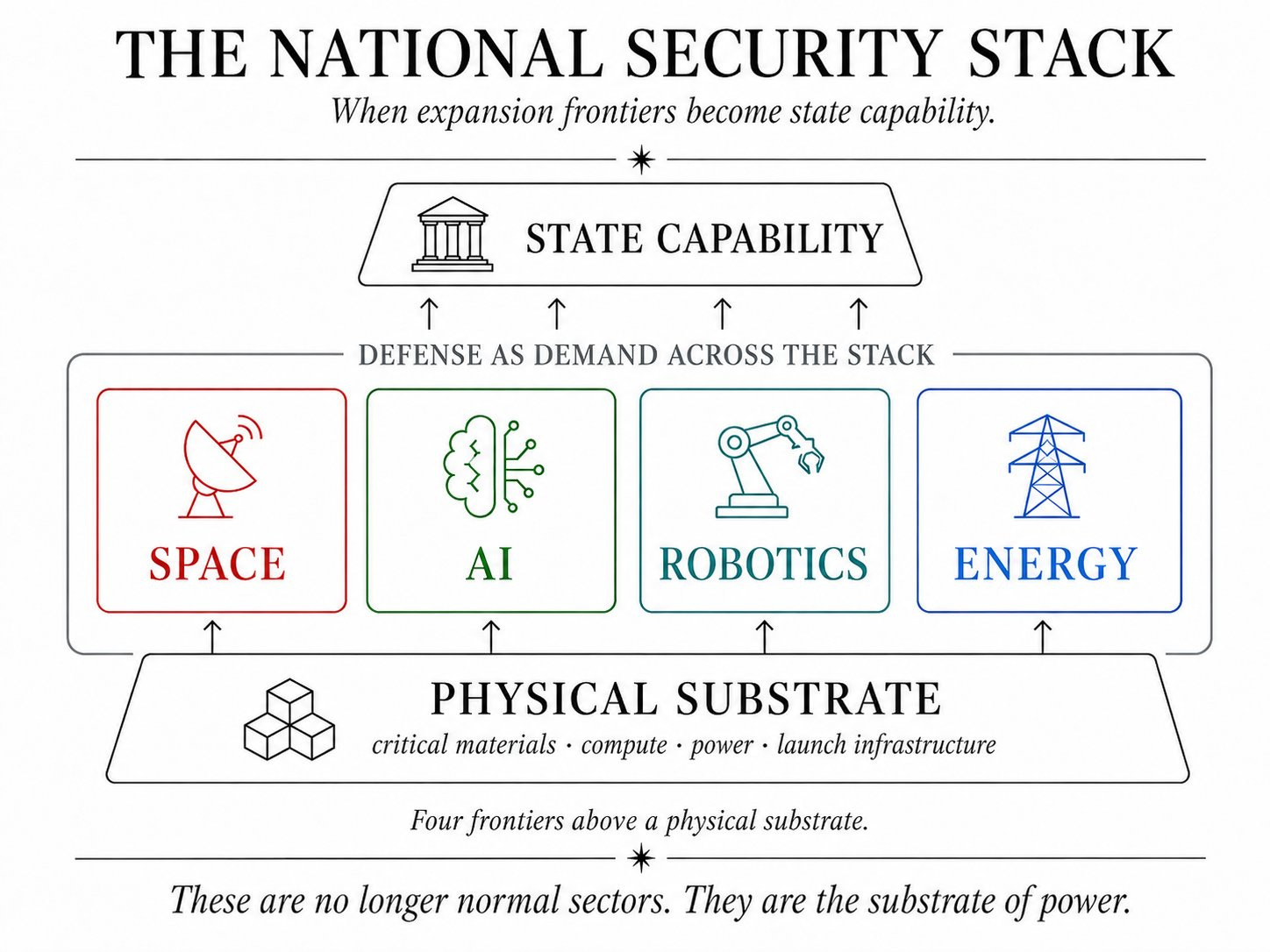
The Four Frontiers. AI, robotics, energy, and space. These are the expansion frontiers. AI expands intelligence. Robotics expands labor. Energy expands power. Space expands territory. Defense is not a fifth frontier; it is the envelope, the state’s demand function running across all four, the form the frontiers take under national-security pressure. Biology is not on the list yet either; it is the inward turn of intelligence, and it enters the stack through the AI layer for now. Together the four frontiers form the National Security Stack.
Stacked Exponentials. Multiple compounding curves running simultaneously and feeding each other rather than progressing independently. The dynamics this produces have no clean historical analog. Linear minds processing them produce systematic underestimates that look reasonable until they suddenly look ridiculous.
The Bottleneck Decade. The roughly ten-to-fifteen year window in which energy, materials, grid, compute, and political systems lag behind technological demand. The window I am writing this paper inside of. The window where the trade is.
The Ownership Problem. The political and economic crisis created when labor loses bargaining power and ownership of automated systems becomes the dominant claim on output. Most of the political conflict ahead is going to be downstream of this.
Citizen Ownership. The broad category of mechanisms that give citizens some participation in the productivity of automated systems. This could take the form of sovereign wealth funds, birthright investment accounts, public equity stakes, tax-advantaged citizen portfolios, tokenized national equity, direct transfers, or some future structure we have not named yet. Universal Basic Equity is one possible version: a minimum civic stake in the productive base of the society a citizen belongs to. Not equal ownership. Not equal outcomes. A floor, not a ceiling. The important point is not the instrument. The important point is that a society where labor loses bargaining power needs some mechanism for broad participation in capital ownership.
The National Security Stack. AI, robotics, energy, space, and the critical materials underneath them are no longer normal sectors. They are state capability. Defense is the envelope around them, the form they take under national-security pressure, not a separate sector beside them. Once a company enters this envelope, it stops being priced like a normal business.
The Redraw of Reality. AI-generated visualization making previously invisible systems visible to ordinary humans, and memetically transmissible at the speed of the feed. A new telescope and microscope for public consciousness, with a corresponding propaganda surface. Whoever can compress a complex system into a viral visualization effectively defines what the public believes that system is.
The Coalition of Fear. The politically incoherent but emotionally coherent alliance of groups that oppose technological acceleration for incompatible reasons, with AI as the current symbol and easiest target: labor displacement, surveillance, religious and moral concern, institutional distrust, credential collapse, creative extraction, concentration of power, and fear of civilizational loss of control. Many of their concerns are real, and some of their critiques are coherent analytical positions rather than fear responses. The shared weakness across the coalition is that resistance has no shared alternative to the buildout.
The Hold. The behavioral discipline required to remain positioned through structural volatility. The actual alpha in this transition is not picking the trend, it is staying on it long enough for it to compound.
Mythic Horizon. The far edge of the thesis. Not trades for today. Not spreadsheet items. The long arc: orbital biospheres, longevity escape velocity, off-Earth cities, full Singularity dynamics. I name them honestly. I do not bury them in the analytical sections.
II. The Comprehension Gap
The single largest barrier to seeing any of this clearly is not lack of information. It is the architecture of your own mind.
The human brain was not built to comprehend exponential growth. We were built to track tigers, seasons, and gradual changes in a herd or a forest. Our entire intuition system runs on linear extrapolation, because for the entire evolutionary history of our species, linear extrapolation was good enough.
It is no longer good enough. The world we are walking into compounds. Compounding breaks human intuition in a specific, predictable, expensive way.
The famous version of this is the rice on the chessboard. One grain on the first square. Two on the second. Doubling every square. By the eighth square, you have 128 grains. Manageable. By the fortieth square, you have over a trillion. By the sixty-fourth, you have more rice than humans have produced in all of recorded history. The math is correct. The intuition is wrong. Almost nobody, including educated people, including investors, can hold that picture in their head.
This is why almost every major technology of the last century has been simultaneously overhyped in the short run and underestimated in the long run. The phenomenon has a name. Amara’s Law: we overestimate the impact of technology in the short run and underestimate the effect in the long run. Cars. Electricity. Computers. The internet. Mobile. AI. Each was dismissed as overhyped after its first peak of attention. Each then transformed the world far beyond what its original advocates predicted.
There are several technical laws that govern what is happening, and each one matters for an investable reason.
The Laws That Govern This
Moore’s Law. Functional AI compute per dollar keeps falling, even as classical transistor scaling slowed. Implication: the cost curve expands the market faster than near-term margin compression can absorb. Margin-compression scares are buying windows, not disconfirmation.
Wright’s Law. Cost falls predictably as cumulative production rises. Solar, batteries, and memory chips all rode it. Implication: humanoid robotics is next. The first ten thousand units will be expensive. The ten millionth will be cheap. Nobody is pricing that curve.
Jevons Paradox. Greater efficiency increases total consumption, not less. Implication: as intelligence gets cheaper, total demand for it explodes. The “AI commoditizes, margins collapse, bubble pops” thesis is wrong about the system even where it is right about specific products.
The Stack
Single curves are hard for human brains to track. The harder problem is that these curves do not run in isolation. They multiply.
Cheaper compute, applied to better algorithms, running on more efficient energy, produces more capable AI. More capable AI, embedded in better robotics, manufactured at scale on Wright’s Law cost curves, produces a labor force that compounds without payroll. That labor force, applied to building more compute, more energy, and more robots, accelerates every other curve. Each output becomes the input to the next round.
We are entering a regime of stacked exponentials. The dynamics have no clean historical analog, and linear intuition keeps producing estimates that feel sober right up until they look absurd.
That is the comprehension gap. It is also the asymmetric opportunity. The people who can hold the stacked-exponential picture in their head, even imperfectly, are going to be positioned for the structural moves while everyone else is debating whether the technology is overhyped.
The “overhyped” debate misses the point. Short horizons run hot. Long horizons run cold. Almost nobody can hold both of those statements in their head at the same time.
III. The Repricing of Intelligence
In 2020, frontier language models could already produce impressive prose, but they were unreliable novelties rather than dependable tools. In 2026, frontier models are scoring at or above expert level on graduate-level benchmarks across mathematics, biology, law, and medicine, including exams that were considered out of reach even three years ago. They are writing production code. They are running experiments. They are operating computers autonomously. They are coordinating with each other.
This did not happen because of one clever insight. It happened because a brutally simple recipe kept working: more compute, more data, better algorithms, applied iteratively. Every six months, the recipe scales. Every six months, capabilities jump.
The pattern is not mysterious anymore. And it is still being underestimated, because capability scaling is exponential and the human brain processes the world linearly.
Important distinction: model capability is not deployment. A model that wins a benchmark is not the same as a model that has been integrated into a workflow, regulated, insured, and trusted with real consequences. The first runs ahead of the second by years. Both are happening. The deployment lag is real and matters for the trade.
The capability trajectory is not subtle. Frontier models landing in 2027 and 2028 will be qualitatively different from today’s. They will do extended autonomous work over hours, days, and eventually weeks. They will take a vague human goal, decompose it, execute, hit obstacles, replan, and complete.
Think of each frontier model as a drop-in knowledge worker who never sleeps, never quits, costs orders of magnitude less than the human equivalent, and can be cloned a thousand times in parallel. One worker today. Thousands soon after. Eventually, millions of parallel agents operating against the same class of task.
That is a research engineer. That is a lawyer. That is an analyst. That is a software developer. That is a scientist.
Zoom in from the macro picture to the individual. In ten years, any person with internet access will be able to operate like a company, with a powerful AI team around them. Research, writing, coding, analysis, design, scheduling, accounting, legal review, customer service. Tasks that previously required teams or agencies become solo work, executed at scale. The reverse is also true. Enterprises will increasingly run on AI-native operating systems where humans set direction and the system executes. The unit of economic production is being redefined at both ends.
This is what some have started calling Software 3.0. The model is not an app you open. It is the operating system the apps run on. The chatbot was the first surface, the way the command line was the first surface for the personal computer, and it is just as misleading about where the value sits. The interface is not the thing. The substrate underneath it is the thing, and the substrate is compute, models, and energy.
This quietly breaks the logic that explains why companies exist at all. Firms formed because coordinating people inside an organization was cheaper than transacting for every task on the open market. When AI collapses the cost of execution and coordination, that logic weakens, and the smallest viable unit of serious economic production keeps shrinking.
You can argue about timelines. The direction is much harder to argue with.
The labs know this. The hyperscalers know this. The sovereigns know this. That is why hundred-billion-dollar capex commitments are being made in months instead of years. That is why nation-states are scrambling to build domestic compute. That is why the energy contracts being signed for AI training runs are larger than the entire grid load of mid-sized countries.
The repricing of intelligence is not just a thesis. It is an observable buildout. The cement is being poured, the chips fabricated, the transformers installed, the fiber laid. You can see the future being constructed in physical space if you know where to look.
The Repricing of Human Labor
The repricing has a shadow, and the shadow has a name. Human labor, as the foundational economic unit of civilization, is being repriced. Mental labor first. Physical labor second.
The first wave is already underway. It is invisible because it is not happening through layoffs. Yet. It is happening through hiring freezes, through silent productivity gains, through teams of three doing the work of teams of fifteen. Companies are not announcing “we replaced you with AI.” They are announcing “we are flat year over year on headcount” while revenue per employee climbs. They are announcing “we are more profitable per employee than ever.” They are announcing “we are deploying productivity analytics across the organization.” Same thing measured from different sides.
They are also building the dataset that finishes the job. Surveillance tools rolled out across employee workstations under the banner of “productivity analytics” capture the workflows, decisions, and outputs that future models will be trained on. Workers are being monitored not to make them more efficient. They are being monitored to make their replacements possible.
Watch the entry-level job market. The bottom rung of the corporate ladder is being sawed off in software, law, finance, consulting, design, marketing, and research. Not because young people are lazy or unskilled. Because the work that used to be junior work is now done by a model in eleven seconds for two cents.
This is the leading indicator. The wave moves up the skill curve from there.
The second wave is robotics, and it has not started yet at scale. The bottleneck has never been the body. It has been the brain inside the body. The body has existed for years. The actuators, the sensors, the batteries, the kinematics. The hard part was getting a machine to look at a messy, unscripted, real-world environment and act in it precisely. That problem is now being solved by the same models that are eating mental labor, ported into bodies.
When you understand that, you understand why the same people who are betting tens of billions on AGI are also betting tens of billions on humanoid robotics. They are not separate trades. They are the same trade with two outputs.
Over the next decade, humanoid robots move from demos and pilots into real commercial work: warehouses first, then factories, construction, and logistics, then the harder service environments. The deployment curve inflects sometime in the 2030s. Most observers are modeling linear adoption; the actual path is closer to exponential, and the gap between those two curves is where the mispricing lives. By the time the Bottleneck Decade closes, the “human labor versus machine labor” question will be settled across many physical domains, and the economically interesting question becomes how the productivity gets distributed.
That last question is everything.
Robotics is the frontier where I am most likely to be early. The direction is obvious; the timing is not. Software scales instantly. Hardware does not. Actuators, batteries, safety cases, manufacturing yield, and reliability in unstructured environments all gate the curve. If this thesis is early anywhere, it is here. I expect to be wrong on timing before I am wrong on direction.
The death of human labor is not the death of human meaning. Those are two separate questions, and the people who conflate them are going to make terrible policy. The question is not whether humans will have purpose. The question is what economic and political arrangement we settle on while we figure out the next chapter.
But repricing is not uniform, and this is the part most automation commentary misses. The same tools that erase the value of average work multiply the value of exceptional work. A great engineer with AI is not 20% better than before. They are operating at a level that previously required an entire team. A great analyst, a great founder, a great researcher, a great operator: each one, paired with these systems, produces at a scale that had no precedent. The curve does not flatten. It bends into a K. The bottom and the middle of many fields get compressed while the top breaks away to levels of output and leverage that were physically impossible a decade ago. Same tools. Opposite outcomes, depending on which end of the curve you are on. The leverage is the largest it has ever been for the people who can wield it, and the smallest it has ever been for the people who cannot.
The fight over distribution is going to be brutal. It will look like culture war. It will look like class war. It will look like generational war. Underneath all of those surface fights, the real fight is about how to distribute the output of a civilization that no longer needs most of its citizens to produce its goods and services. That is the deep current. Every political conflict on the road to 2045 is going to be downstream of it.
The Third Repricing: Biology
There is a third repricing that belongs in this chapter, and it is large enough that readers may be tempted to treat it as a fifth frontier. Not yet. Biology is not a separate pillar beside the four frontiers today. It is the inward turn of intelligence: the same frontier, pointed at life itself rather than at silicon. For now it enters the stack through the AI layer. Most market participants are still treating it as venture-stage speculation. They are wrong.
Intelligence is being repriced through AI. Physical labor is being repriced through robotics. Biology itself is being repriced through the application of AI to the molecular and cellular layer. The third repricing is happening on the same curves as the first two, and it is going to be every bit as consequential.
For a hundred years, drug discovery has run on brutal economics: roughly a billion dollars and ten to fifteen years per approved drug, most candidates failing along the way. The bottleneck was never chemistry. It was the combinatorial search space, too many possible molecules and targets, too few experimental cycles per year. AI is collapsing that bottleneck.
Protein structure prediction is largely solved for most single proteins. The overwhelming majority of meaningful proteins, including ones never crystallized in a lab, can now be modeled to working accuracy in minutes, and the same models are learning to predict function, interaction, and small-molecule binding. The discovery loop is compressing from years to months to weeks. Automated end-to-end labs are turning what took a team of fifty PhDs into closed-loop systems that generate candidates, test them, learn, and iterate without human bottlenecks.
The categories that follow from this are real, near-term, and underpriced.
Drug discovery acceleration. AI-native pharma is bringing candidates into trials faster, with better target selection than legacy pharma. The track record is still short, but the economics of the whole industry are being rewritten regardless.
Aging biology and cellular reprogramming. The science of why cells age, and how to reset them, has moved from speculation to a real engineering discipline in the last five years, with the first interventions already in early clinical trials. My aggressive case is that early wealthy access arrives within a decade, with broader developed-world access within a generation.
Gene editing at scale. CRISPR has moved from one-off proofs of concept to a real pipeline. The first FDA-approved CRISPR therapy treats sickle cell; the next wave treats a long list of genetic conditions, and after that, broader applications including age-related disease.
Synthetic biology as a manufacturing platform. Engineered organisms producing materials, fuels, food, and pharmaceuticals at lower cost than petrochemical or agricultural processes. This is industrial chemistry running on biology rather than against it.
The market is treating most of this as speculative. The buildout is real. The capital is flowing. The talent migration into biotech-AI is one of the cleanest leading indicators in the field. By the time the Bottleneck Decade closes, biology will be one of the largest categories of repricing in the economy, alongside AI and robotics. Most observers will look back at the late 2020s and say it was obvious. It is not yet obvious. That is the trade.
Alpha: the AI-bio interface is the unlock for the next decade of medical fortunes. Some of it captured by legacy pharma entrenching its position. Some by AI-native challengers. Some by entirely new categories emerging from breakthroughs we cannot yet name. The winners will be whoever integrates machine learning into discovery and trials deepest. Bet on the integration, not the company type.
The Market Read
The companies and countries that build the means of automated production are going to capture a much larger share of total economic output than is currently priced. The companies and countries that fail to build them are going to be reduced to economic dependencies. The gap between the two will be enormous.
A note on evaluating the model layer itself. The right way to assess AI labs is not raw capability. It is the tradeoff between intelligence and cost. A model that is marginally smarter at ten times the price loses to one that is nearly as smart at a fraction of the cost. The leaders on this curve rotate faster than most observers track. A lab that dominates the intelligence-per-dollar frontier one quarter can fall off it the next when a competitor makes a sharper architectural bet. This is why “who is winning AI” is the wrong question. The question is who sits on the cost-adjusted frontier right now, and that answer keeps changing.
You either own the machines, or you do not. That is the trade.
Alpha: own the substrate, not the application layer. Compute, energy, and chip architectures capture the value the application layer competes away.
IV. The Energy and Materials Reckoning
You cannot run intelligence at this scale on the current grid. You cannot run robotic civilization on the current grid. You cannot run space industrialization on the current grid.
The grid was built for a world that no longer exists. The world we are walking into needs significantly more power, distributed differently, generated differently, and built faster than current permitting and construction timelines allow.
This is not opinion. It is arithmetic.
That is why I am not merely bullish on energy companies. I am bullish on energy expansion itself. The market is obsessed with the intelligence layer. I think the true choke point this decade is the physical layer underneath it: electrons on the wire, uranium in the ground, gas in the turbine, copper in the cable, transformers in the yard, and interconnection agreements in the queue. Software compounds at the speed of deployment. Power compounds at the speed of steel, concrete, mines, substations, and public approval. That mismatch is the trade.
The IEA projects global data center electricity consumption rising from roughly 415 TWh in 2024 to around 945 TWh by 2030, more than doubling in six years. In the United States, data centers account for nearly half of projected electricity demand growth between now and 2030. This is not a normal load-growth cycle. This is a new industrial demand curve landing on a grid built for a slower world.
The supply side cannot follow cleanly. Berkeley Lab’s latest interconnection data shows more than 2,060 gigawatts of generation and storage capacity actively seeking U.S. grid connection as of the end of 2025. The 2025 edition showed roughly 10,300 active projects in the queue at the end of 2024, representing 1,400 GW of generation and about 890 GW of storage. Most projects that enter interconnection queues are withdrawn, and the ones that get built are taking longer to move from request to operation.
The bottleneck is not just megawatts. It is hardware. Large power transformer lead times now average roughly 128 weeks, with generator step-up transformers running around 143 to 144 weeks. The United States remains heavily exposed to imported transformer supply at the exact moment AI, electrification, renewables, and grid replacement are all pulling on the same equipment stack.
The hard version of the claim is this: if the energy buildout does not arrive on the AI buildout’s timeline, the AI buildout itself stalls. Not because the algorithms fail. Because the power does not show up. Google has already identified the U.S. transmission system as the biggest challenge to connecting data centers, with grid connection delays reaching up to twelve years in some regions. Hyperscalers are responding by contracting power directly, colocating near generation, building or exploring on-site power, and treating time to power as the binding constraint on revenue rather than chip procurement.
So we are going to build everything. Nuclear is back, real nuclear, not just SMRs. The first new full-scale fission plants built in the United States in decades have come online. Politicians who would have lost their careers for supporting nuclear ten years ago are leading the charge. It is hard to see a full AI buildout without significant nuclear. Natural gas is the ugly bridge. It is not the final answer, but it will carry more of the Bottleneck Decade than clean-energy purists want to admit. Solar and wind scale but cannot carry industrial-grade base load. Geothermal could become a bigger story than current consensus assumes. Fusion is coming, and when it arrives at scale, it changes the price of everything.
But the bottleneck is not generation. The bottleneck is the physical inputs.
To build the grid required for the next twenty years, you need staggering quantities of copper, steel, aluminum, lithium, uranium, rare earths, silver, nickel, and cobalt. The mines that would produce these materials in the volumes required have not been built. Some have not been permitted. The IEA projects a roughly 30% copper supply deficit by 2035 under current pipelines. New copper projects take about 17 years from discovery to production. Most rare earths processing capacity is currently in China.
We are about to spend a decade trying to build a 2050 grid with a 1990 supply chain.
Uranium deserves its own treatment. Demand is inflecting from both sides. AI is the largest new electricity demand in modern history, and the only baseload that scales without hydrocarbons is fission. Supply is structurally constrained. Processing capacity sits in jurisdictions the West cannot rely on. New mines take a decade. The uranium trade is the single cleanest expression of the AI buildout meeting the energy bottleneck.
This is where energy stops being a market story and becomes a security story.
The countries that lock up copper, uranium, rare earths, processing capacity, and grid hardware win the buildout. The countries that do not become dependent. We are already in the early phase of the resource wars. Not always with armies. More often with financing, proxies, mercenary companies, export controls, basing rights, drone coverage, and quiet mineral contracts being signed in ways that mostly do not appear on television. By the mid-2030s, this will be one of the dominant security frames in the world.
The dominos are sequenced. AI improves the math models that improve materials science. Better materials science unlocks better batteries, better superconductors, better solar, better grid hardware, and eventually working fusion. Better energy makes more AI possible. The loop closes. Each round of the loop is shorter than the last. Researchers who have lived through five-year discovery cycles in materials are watching the same work happen in months. The same domino chain runs through biology, chemistry, and structural engineering. The cascade is what makes the bottleneck decade end. It is also what makes the post-bottleneck decade look nothing like the current one.
The price implications are obvious. Hard commodities, especially the ones that are critical and supply-constrained, are going to experience a structural bull market that lasts until either supply catches up or demand collapses. Neither is happening on the current trajectory. Copper, uranium, and gold are not trades. They are positions you hold for the decade.
There is a second-order effect worth understanding. In a genuine supply shortage, the lowest-quality producers reprice the hardest. The high-cost marginal supplier that was near bankruptcy when supply was loose becomes a cash machine when demand outruns capacity. This is standard commodity-cycle behavior, and the energy and grid buildout will follow it. The cleanest assets compound steadily. The marginal, high-cost, previously-uneconomic capacity moves violently when the shortage hits. Both are part of the trade. Understand which one you are holding, because the violent movers are rentals, not homes.
Beyond the commodities, the second-order trade is the energy infrastructure itself: transmission, transformers, switchgear, cooling, storage. The boring physical layer of the grid is suddenly strategic. Companies that make these things are sitting on multi-decade backlogs and pricing power they have not had since the 1960s.
This is also the sector where you see the most unambiguous signal that government and capital are aligned. Industrial policy is back. Subsidies are flowing. Reshoring is happening. When both parties suddenly agree on power, grid security, and minerals, pay attention. They have seen the same numbers.
The numbers are: build, or fall behind permanently. We are going to build.
Alpha: the scarce inputs to the buildout are scarcer than the buildout itself. Copper, uranium, rare earths, grid interconnection, and processing capacity outperform the equipment built on top of them.
V. The Expansion Into Space
For most of the first space age, space was state-led, state-funded, and state-gated. That changed when reusable launch turned access to orbit from a government program into an industrial cost curve. What comes next is a frontier in the historical sense of the word: a place where civilization expands, settles, and extracts.
There is a deeper frame underneath all of this. The Kardashev scale, first proposed by Soviet astrophysicist Nikolai Kardashev in 1964 and revived in the current tech conversation by Musk, classifies civilizations by how much energy they harness. We are still below Type I: a civilization that has not yet fully captured the usable energy of its home planet. Climbing further requires expanding the energy budget, and the path to capturing stellar-scale energy eventually runs through space.
This is where two of the frontiers stop being separate. The ultimate energy opportunity and the ultimate space opportunity are the same opportunity. The sun radiates more energy in an hour than civilization uses in a year, and almost all of it misses the Earth entirely, streaming past us into empty space. A civilization that wants to keep expanding its energy budget eventually stops fighting over the sliver that reaches the ground and goes to where the energy actually is. Energy becomes a space problem, and space becomes an energy story. The near-term expression is terrestrial; the bottleneck decade is fought on the grid, with uranium and copper and transformers. But the direction of travel, across a long enough horizon, points off-planet, and the same launch and orbital-infrastructure layer the rest of the space thesis depends on is what eventually makes it reachable.
Reusability collapsed launch costs by an order of magnitude in less than a decade. Another order of magnitude is coming. Compress the cost of access to orbit by two orders of magnitude and you do not get a slightly bigger space industry. You get an entirely new physics of what is economically viable.
There is a second accelerant beneath the cost curve, and it is the same one driving the rest of this paper. AI is compressing the physics and materials loop that space hardware runs on. The same models accelerating drug discovery and materials science are being pointed at the hard engineering problems of getting to orbit and operating there: lighter and more heat-tolerant alloys, better combustion and propulsion modeling, faster simulation of launch, reentry, and orbital mechanics that used to eat years of compute and wind-tunnel time. This is not AI discovering new physics, it is AI collapsing the cycle time on the applied physics and engineering we already know, the same way it is collapsing the discovery cycle everywhere else. Every turn of that loop makes the hardware cheaper, lighter, and more reliable, which bends the launch cost curve faster than rocketry alone would. The space frontier is accelerating partly because the intelligence frontier is feeding it.
By 2040, the space economy will include categories that are barely investable today: orbital manufacturing, lunar logistics, in-space resources, space-based defense, and settlement infrastructure. Some of these have already started to attract serious capital. Orbital compute is no longer hypothetical. Others are still a decade from being real businesses. The internet looked the same in 1998. The substrate fills in. Then the substrate gets used in ways the original mappers could not see.
Launch is the toll road. The whole space economy sits on top of cheap, reliable, high-cadence access to orbit. Whoever owns the launch layer prices everything above them in the stack. The current structure of the market makes the point: one provider has driven cost-per-kilogram down by an order of magnitude and now runs the majority of global launch cadence, which is exactly why it is treated by the state as strategic infrastructure and priced by the commercial market it dominates. After launch, the most valuable layer is constellations: communications, earth observation, positioning, weather, defense, surveillance, and applications nobody has invented yet. The orbital infrastructure layer will be more valuable than terrestrial telecom infrastructure ever was.
Beyond infrastructure, the next layer is manufacturing and resources. Microgravity changes physics. Some materials are dramatically better made in orbit. The category moves from curiosity to real sector as launch costs fall. Asteroid resources are a longer-duration story: platinum group metals, water, and rare earths in volumes that dwarf Earth’s reserves. The economics of bringing them down do not work yet. The economics of using them in orbit work much sooner. Water in orbit means fuel in orbit. Fuel in orbit opens the solar system.
Orbital compute. As launch costs collapse, orbital data centers are becoming a serious candidate for the outer edge of the compute stack. The advantages: continuous solar exposure, passive cooling, no permitting fights, no zoning battles, no water disputes. The bottlenecks: launch cadence, on-orbit maintenance, harsh-environment engineering, latency, bandwidth. Most of these are real constraints right now. None of them survive the long run. The Starship cost curve is what makes the math work. The space substrate seems inevitable to me. The only real question is timing. The Bottleneck Decade does not depend on orbital compute being right; it is upside on top of a thesis that stands without it.
Space is now a war-fighting domain, and every serious nation knows it. The investment flow is following. Settlement of the moon and Mars is slow, expensive, and dramatic. Mythic horizon: eventually, there will be early cities.
Launch capacity is national security infrastructure. Orbital compute is downstream of the energy and compute thesis. Asteroid resources are the hundred-year answer to the materials bottleneck. The companies that own meaningful pieces of the space stack are likely to capture wealth at a scale the market is not yet built to price. Where the largest pools of private and public capital are already flowing is a tell about where the next century goes.
Humans expanding off-planet is not a side effect of technology. It is what life does. Single-celled organisms colonized the oceans. Then the land. Then the air. Consciousness keeps reaching outward. We are crossing from a one-planet species to a multi-planet one.
People who feel that will be drawn to the space trade in a way that has nothing to do with quarterly earnings. People who do not will misprice it. The mispricing is the opportunity.
VI. The Erosion of Money
The dollar, as you have known it, is changing. Not in whether it remains globally dominant. In whether it remains a stable long-duration store of purchasing power. It is not going to disappear. It is going to slowly transform into something more managed, more debased, and ultimately a unit of political power rather than a stable store of value.
This is not a crash thesis. It is a slow-motion thesis. The mechanism is structural.
The United States now carries approximately $39 trillion of federal debt. The math on servicing it does not balance through cuts or taxes alone. Not at current interest rates. Not under current entitlement obligations. Not given current defense commitments or demographic trends. It balances through some combination of growth, financial repression, and inflation. Politically, inflation is the path of least resistance, which is why it tends to do the heaviest lifting. The debate is not whether the fiscal path is strained. The debate is how long markets will tolerate it, and which mechanisms absorb the imbalance.
The obvious objection is U.S. exceptionalism, and it is real. Deep markets, dollar inertia, the strongest alliance structure, and AI-driven productivity could all extend the fiscal runway. That is why this is not a dollar-collapse thesis. It is an erosion thesis. The dollar can remain dominant while becoming a worse long-duration store of purchasing power.
“The Fed is going to keep printing” is too imprecise. The mechanisms are several:
Direct balance sheet expansion through QE in response to crises.
Tolerance of inflation above the 2% target for extended periods.
Emergency lending facilities that backstop specific sectors (banking, money markets, repo).
Implicit accommodation of fiscal deficits through Treasury market interventions.
Regulatory changes that encourage banks and insurers to absorb sovereign debt.
These are not equally likely in any given crisis. The pattern is that whichever lever is politically available gets pulled, and the result on long-duration purchasing power is similar regardless of which mechanism. The Fed balance sheet stood at roughly $6.7 trillion as of April 2026. The point is the direction, not the date.
What does break look like? A bank failure, a sovereign auction that does not clear, a credit market freezing, a foreign holder dumping treasuries. The specific trigger does not matter. The response will. More liquidity, lower rates, larger balance sheet, longer than anyone expected, deeper than anyone forecast.
Large corporations want the machine to keep running. Monetary stimulus disproportionately flows to the most leveraged, most politically connected companies. Their cost of capital collapses, their lobbyists get bigger budgets, and the next round of stimulus arrives faster. The bailout machine is a permanent feature. Every bailout makes the next one more likely. The public balance sheet has no hard limit, only a soft one called inflation, crossed gradually and then suddenly.
Here is the part of this argument I have not seen made clearly elsewhere. The AI buildout itself increases the probability of financial repression in a way previous cycles did not.
Look at the capex required. Stargate-scale data centers. Grid expansion. Critical mineral processing onshored at any cost. Every one of these is too large for normal capital allocation, too strategic to lose, and too slow to wait for organic returns. They get underwritten by the state.
When required capex exceeds what private markets can fund on commercial terms AND the assets are deemed strategically essential, the state underwrites them. Not always through direct spending. Often through guarantees, yield suppression, regulatory capital treatment, emergency facilities, and balance-sheet expansion. The AI cycle is the first where capex requirements collide with fiscal limits at the moment geopolitical stakes make withdrawal impossible. That collision produces structural debasement. The buildout cannot be lost.
The implication is direct: if you want to preserve and grow real wealth across the next twenty years, you cannot trust the unit of measurement. You have to own things that cannot be printed. Hard assets. Productive assets. Scarce assets.
Gold has been doing its job quietly for five thousand years. That is the Lindy effect made literal: the longer something has survived, the longer it is likely to keep surviving. Five thousand years of monetary status is data. Eighty years of dollar reserve status is hypothesis. Central banks know this. They are buying it at historically elevated levels, broadly distributed across countries. Gold itself has roughly doubled since 2023. The bigger signal is structural: per World Gold Council data, marked to market, foreign official gold holdings surpassed foreign official holdings of U.S. Treasuries in late 2025, the first time since 1996. When the people who run the printing presses are quietly buying the thing that cannot be printed, you should pay attention.
Equities of companies that own real productive capacity, that operate the infrastructure of the future, that generate cash flows that can grow with or beat inflation. These are not safe in the short term. They are essential in the long term.
Real estate in places growing demographically and economically.
What you cannot afford to own, on a twenty-year horizon, is large amounts of long-duration sovereign debt at current yields, denominated in currencies that are going to be debased to manage that same debt. That is the trap that pension funds, insurance companies, and conservative retail investors are sitting in right now, and most of them do not realize it.
The erosion of money is not a crash. It is a grind. The grind redistributes wealth from holders of paper claims to holders of real things. The redistribution is going to be one of the largest in modern history. It is already underway. You can either be on the right side of it or the wrong side of it.
Lindy is not just a monetary heuristic. It is a survival pattern that applies to anything humans carry across generations. Religions, brands, languages, recipes, institutions. What survives gets more durable the longer it survives. It is the meme nature of human civilization itself. The old becomes harder to replace the older it gets.
Alpha: hard assets, productive ownership, multiple income streams, low single-source dependencies. The dollar is not collapsing. Its purchasing power over real things is.
VII. After Unipolarity
Empires do not collapse cleanly. They transition. They do it badly, expensively, and over decades.
The American empire constructed after 1945 is in transition. That sentence will get read as alarmist or anti-American depending on who is reading it. It is neither. It is structural.
The Pax Americana was built on overwhelming military superiority, dollar hegemony, manufacturing dominance, energy depth, demographic vitality, institutional trust, and cultural confidence. Most have weakened. None are unchallenged.
China is the central competitor, and it is in a category of its own: the only nation able to contest the United States across every domain at once. Manufacturing, AI, energy, space, defense, and the industrial base underneath all of them. It is not a regional power testing the edges of American influence. It is a peer building a complete alternative to the American-led order, and the competition with it will define the geopolitics of the next several decades. The deep structure of the next era is bipolar: two poles, the United States and China, each anchoring a technological, financial, and military sphere. Everyone else is consequential but not co-equal. India, the Gulf, Brazil, and the rest are the contested middle, hedging between the two poles, building leverage by refusing to fully commit to either. The reorganization of South-South trade and the slow construction of payment rails outside the dollar system are real, but they resolve into which pole a given country leans toward, not into a world of many independent centers.
This is not American collapse. The U.S. is still the most innovative economy, the most militarily capable nation, the most attractive destination for global capital, with the deepest financial markets, most dynamic startup ecosystem, and largest reserve of soft power. None of that is going away in the next twenty years.
What is going away is the unipolar moment. The post-Cold War assumption that American norms, American institutions, and American currency would continue to set the global default. That assumption has been dying for a decade.
The transition is going to be expensive, and the expense will fall heavily on defense. You cannot maintain the obligations of the post-1945 order on the budgets of the post-1990 peace dividend. Funding levels are going up. Significantly. Permanently. Defense spending is no longer a political variable. It is a structural one, with bipartisan support that strengthens every year as the geopolitical environment hardens.
What the defense spending funds is also changing. The 2020s proved a new generation of capability in Ukraine: software-first, drone-first, autonomy-first, attritable, manufacturable at scale. The 2030s capture the procurement budget. The 2040s dominate. The next chapter is dedicated to that integration.
There is a deeper point here, which is that geopolitical fragmentation is driving duplication. China is building a parallel stack. India is building a parallel stack. Europe is building a parallel stack, finally. The Gulf is building its own stack with help from whoever will sell it. Every major power is now duplicating the entire technology pyramid: chips, AI, energy, space, defense.
That duplication is enormously expensive. It is also enormously stimulative. The companies that supply the duplication are going to do extraordinarily well. The geopolitical dynamic that forces the duplication is permanent. The unipolar moment is over. The duplicated world is the new normal.
For most of the post-Cold War era, frontier technology in the West treated itself as politically neutral. Customers were agnostic. Defense work was a stain rather than a duty. That posture worked when the West was the only game in town. It does not work now.
Competitors are not impressed by Silicon Valley’s pacifism. They are exploiting it. China has built a fully integrated state-industrial-military complex around AI, robotics, surveillance, and weapons. They have not debated whether technology should serve national interests. They have assumed it does and built accordingly.
The companies that figure this out early will be in a category of their own. The ones that are still posturing about whether to take defense contracts in 2030 will look like the ones who refused to take internet contracts in 1995.
VIII. The National Security Stack
The line between “civilian technology company” and “national security asset” is dissolving. In real time, on the timelines that matter now.
A data center that trains frontier models is national security infrastructure. A factory that produces humanoid robots is national security infrastructure. A chip fab, a uranium enrichment facility, a rocket launch facility, a rare earth processing line. All of it. The buildout now underway is not happening alongside national security policy. It is becoming national security policy.
This is the National Security Stack. It is the integrated set of frontier industries that nation-states now treat as strategic assets rather than commercial sectors. The four frontiers of this buildout (AI, robotics, energy, space) are not separate sectors that happen to be growing. They are pieces of a single national capability stack, and serious states are organizing themselves to control as much of that stack as they can.
You may notice defense is not on the list, because it is not a frontier; it is the envelope. It is what the other four become under pressure, the state’s demand function running across all of them. A drone maker is robotics with a government customer. A launch provider is space with a clearance. There is no defense sector in this framework. There is the stack, and the share of it the state claims.
Biology is not on the list either. It is coming. For now, bio enters the stack through the AI layer: every frontier lab already treats biological capability as a weapons question, and the policy apparatus is beginning to agree. But the four frontiers above are defined by physical buildout the state can fund, fence, and defend. When governments start buying biological capability the way they buy launch, the stack gets a fifth pillar.
What It Looks Like
Data centers are going to be hardened, defended, and in some cases physically protected by uniformed personnel. The new clusters are critical infrastructure under multiple legal frameworks, and the operational security requirements will reflect that.
Robot factories are going to be subject to export controls, security clearances, and protected status under critical infrastructure law. The companies producing humanoid platforms at scale will find themselves negotiating with defense ministries the way semiconductor companies negotiate today.
AI models above a certain capability threshold are already treated like weapons systems for purposes of export, deployment, and ownership. Washington decides which chips cross which borders, and in 2025 it began taking a cut: the two leading AI chipmakers agreed to hand the US government 15% of their China chip revenue in exchange for export licenses. A state toll on the outbound flow of strategic capability.
Energy infrastructure that supports the buildout (nuclear plants, enrichment, transmission, critical commodity supply) is being subsidized, fast-tracked, and strategically directed. Several G7 governments are implementing forms of intervention in their domestic energy stacks that would have been unthinkable a decade ago.
Space infrastructure is already partly classified. It is becoming more so. Launch capacity, orbital sensing, satellite communications, and lunar logistics will operate inside frameworks that look more like the defense industrial base than the commercial telecom industry.
Critical materials are the stack’s most concentrated national-security exposure. Copper, lithium, rare earths, tungsten, antimony, gallium, germanium. China largely controls the processing for all of them, and Beijing has stopped pretending otherwise: an outright ban on gallium, germanium, and antimony exports to the US in late 2024, then rare earth and magnet controls in April 2025 that froze Western auto lines within weeks, then another tightening in October. These metals are in the missile, the radar, the magnet, the night-vision optic, the engine. An entire generation of Western defense systems runs on a supply chain the West does not control. The reshoring is happening, expensively and with heavy subsidy. The companies building the alternative supply chain are not just being supported. They are being underwritten.
Who Sets the Price
The companies building the stack are going to have government in the room: intelligence liaisons, export rules, security obligations, national-interest constraints that 2010s tech companies would have considered insane. The ones that resist will lose contracts and access. The ones that embrace the integration will gain protection, capital, and structural advantage that nobody outside the security frame can compete with. But state protection is not free. The same designation that brings subsidy, contracts, and capital access also brings price controls, forced domestic sourcing, export restrictions, political oversight, and eventually nationalization risk. Strategic asset status is a moat and a leash.
So which one dominates? The defense primes have held strategic status for seventy years, and it bought them cost-plus contracts, single-digit margins, and returns that came from buybacks rather than growth. If “the government will defend it” were sufficient, Lockheed would have been the trade of the century. It was not. Protected and owned is not a growth story. It is a coupon.
The variable that separates the winners from the hostages is who owns the demand curve.
If the government is your only customer, the leash dominates. You get the moat, and with it a margin cap, procurement politics, and an upside that belongs to the taxpayer. You become infrastructure with a share price.
If the government protects you while commercial markets set your prices, the moat dominates. TSMC is subsidized, defended, and treated by two superpowers as the most important physical asset on earth, and its prices are set by commercial customers bidding for scarce leading-edge capacity. SpaceX is anchored by national security launch and priced by a commercial market it dominates. That is the position: the state guards the gate, the market sets the toll.
The best structure in the stack is the hybrid, the MP Materials deal. A government floor under the downside, commercial demand stacked on top. The state de-risks the capex. The market prices the output. Heads you compound. Tails the Pentagon owns your risk.
The equity itself is the tell. Washington is no longer just subsidizing the stack. It is buying it. The Pentagon on MP’s cap table. Stakes in the lithium and Alaskan copper developers. A golden share written into the US Steel acquisition. The state is assembling a portfolio of the assets it intends to keep, and a state does not let its own book fail. A government stake is the designation made explicit: that company will be defended, subsidized, and utilized, because the taxpayer is now long. The holdings are a published watchlist. But a stake does not change who owns the demand curve. It changes who absorbs the downside.
Intel is the live test of the framework. The state took 10% of a company the market had written off, and the stake alone settles nothing: a backstop under a melting business is still a melting business. Watch what stacked on top. SoftBank put in two billion. Nvidia followed with five billion and a chip partnership within weeks of Washington moving. The deal terms are even built to keep the foundry majority American-owned. What is still missing is the MP move: steered demand. The day Washington starts directing volume to the last American-owned leading-edge fab, this becomes the hybrid at semiconductor scale. That is the long-term bull case, and note what it bets on: the state finishing what it started.
When you look at any company inside the envelope, ask one question: who sets the price? If the answer is a procurement office, you are buying a bond with political risk attached. If the answer is a market, while the state guards the moat, you are looking at the most defensible equity on earth.
The End of the Biological Soldier
One piece deserves its own name.
The era in which the biological soldier is the default unit of deployment is ending. Not all at once, not cleanly, and not everywhere. But the procurement curve is moving away from humans as the first deployed unit and toward drones, autonomous systems, sensors, and robotic persistence. Ukraine settled the argument: small drones now account for the majority of battlefield casualties, and both sides build them by the million per year. Western procurement is reorganizing around that fact. The same humanoid and drone platforms being scaled for warehouses and factories are being scaled, in different versions, for these operations.
Alongside that shift, governments are going to converge on mass surveillance as the operating model in zones where they want to control resources or contain unrest. Drones overhead. Sensors on the ground. Persistent monitoring of populations and movements, executed by systems that do not need to sleep, eat, or be rotated home. This will be presented as security. It will also be the largest expansion of state observation capacity in human history, and it will land first in the places governments care about most: where the minerals are, where the supply lines run, and where the people are restive.
I am not endorsing this. I am telling you it is happening, and that the companies building these capabilities will be among the most valuable strategic assets of the coming decade. Every previous expansion of the military-industrial base has produced both real productive spillover and real destructive consequences. This one will too.
But here is the part most analyses skip: the democracies are starting to draw lines through this market, and the lines are investable. This month, the CEO of one of the leading AI labs published a policy framework calling for fully autonomous weapons to be banned from domestic law enforcement, hardwired to refuse unlawful orders, and for the data-broker loophole that feeds bulk surveillance to be closed. Proposals like that are moving from think pieces toward statute. If they land, the market bifurcates by jurisdiction: domestic deployment constrained by constitutional guardrails, allied and export demand far less so. The companies that can build persistent autonomy for the coalition’s edge while staying inside the guardrails at home will capture both sides of the split.
Do not make the mistake of reading the guardrails as a tax on the thesis. They are what makes the Western stack durable. A security architecture that requires repressing its own population is brittle; it manufactures its own backlash. Legitimacy is a strategic asset too, and it is the one asset the other bloc cannot copy.
How the Market Misprices It
For markets, this is enormous.
The entire stack of frontier technology now operates inside a national security envelope, and the envelope tightens every year. Pricing companies inside this envelope as if they were ordinary consumer or enterprise software businesses is mispricing them. They are dual-use strategic assets in a fragmenting world, with all the upside and all the constraints that designation carries.
This is partly why the largest frontier companies have attracted capital at valuations that look insane to traditional analysts. The analysts are pricing commercial businesses; these are no longer commercial businesses. They are pieces of state capability with a commercial revenue line attached. Sometimes that makes the valuation more rational than it looks: a state backstop under the downside is worth turns of multiple that no spreadsheet captures. And sometimes the same designation is the warning: where the state owns the demand curve, you are holding the coupon, not the compounder.
You either build inside the National Security Stack, or you build around it. There is no neutral position anymore.
Alpha: the strategically protected category is the durable category, but only part of it compounds. Buy what governments will defend, subsidize, and onshore, where the market still sets the price.
IX. After Labor-Capitalism
Capitalism is finishing its job. The system that built modernity, the price-signal-and-property-rights coordination engine that bootstrapped humanity out of agricultural scarcity, is reaching the end of the phase it was designed to run. Not collapsing. Not failing. Completing.
What comes next is not socialism. It is a structural shift in which labor stops being the primary claim on output and ownership of automated production becomes the central economic question. That shift requires a new arrangement that nobody has fully built yet.
Every economic system humans have built is transitional. We tend to forget this because we live inside whichever one is current and assume it is the natural state of things. The peasants of medieval France assumed feudalism was eternal. The post-war managerial class assumed Keynesian capitalism was the end of history. Both were wrong. The transitions between systems are bloody and produce decades of cultural panic, but they also produce the largest expansions of human capability in recorded history.
We are roughly two and a half centuries into the capitalist era and visibly in its late stage. Capital is concentrated to historic extremes. Returns on labor have decoupled from returns on capital. Financial engineering dominates productive engineering as the path to wealth. The owners of capital have decoupled their fortunes from the welfare of the societies that produced them.
One thing to be precise about. I am not describing a moral collapse. I am describing a phase change. Capitalism did not become evil, and it is not being discarded. It is evolving. The price-signal engine that built modernity is entering its next phase, one where ownership of automated production becomes the central question rather than the sale of labor.
Capitalism’s core assumption is breaking: that human labor, applied through capital, produces wealth. Remove or massively diminish the labor input while making capital ten thousand times more productive through automation, and the mechanism that worked for two centuries starts to misfire. The richest companies in the world employ a fraction of the workers their predecessors did fifty years ago, while producing many multiples of the output. The wealth gap is not about whether the system is “fair.” The system was built for a labor-intensive environment, and we are entering a labor-light one.
The next system, whatever we end up calling it, will be organized around different questions. Capitalism asks: how do we coordinate human labor and capital to produce goods and services efficiently? The next system asks: how do we coordinate intelligence, agency, and abundant production to align outcomes with what is best for consciousness and civilization? Scarcity is no longer the central frame. Energy gets cheaper. Goods get cheaper. Even cognition gets cheaper. The bottleneck moves from “produce enough” to “decide what to produce, and how to distribute the output.”
Put it more directly. Every institution on Earth was built to coordinate scarcity. Nation-states, corporations, markets, legal systems, education, religion. All ten thousand years of civilization is downstream of the question “how do we allocate too few resources among too many wants?” That question is the operating system humans have been running. We are about to need a rewrite. The early kernel updates are already deploying. The full migration will take decades.
I am not predicting socialism. Socialism failed because it did not solve the coordination problem capitalism solved. The next system will not be socialism, and it will not be a managed economy. It probably does not have a name yet. What it will have to do is give citizens a claim on automated productivity, and price the things capitalism has been bad at pricing: long-term well-being, ecosystem health, civilizational coherence, the stability of the social fabric.
The Ownership Paths
The standard answer to mass automation is Universal Basic Income. Send everyone a check. Pay it out of taxes on the productivity of the machines. I understand why people reach for it. If labor income weakens, direct income replacement is the obvious first policy reflex.
But UBI has a structural weakness. It makes citizens dependent on the political system for a recurring transfer while leaving ownership of the productive base concentrated elsewhere. It can reduce suffering, but it does not solve alignment. It creates recipients, not participants.
The cleaner question is not “how do we send everyone a check?” The cleaner question is: how do citizens participate in the productivity of a civilization that increasingly produces output through capital, software, robots, energy systems, and automated infrastructure rather than through human labor?
There are several possible paths.
One is direct transfers: UBI, wage subsidies, tax credits, negative income taxes, emergency checks. These are politically simple and will almost certainly appear first. They are also fragile, because they remain dependent on annual politics and fiscal capacity.
Another is radical abundance. If AI, robotics, and energy drive the marginal cost of many goods and services low enough, the need for cash compensation declines. This is the most optimistic path, and parts of it are real. But abundance does not arrive evenly. Housing, land, healthcare, status, safety, and access to elite systems will remain scarce long after many digital goods become cheap.
Another is broad citizen ownership. This could mean sovereign wealth funds, birthright investment accounts, public equity stakes in strategic sectors, tax-advantaged citizen portfolios, or tokenized national equity. Universal Basic Equity is one version of this: every citizen receives some baseline ownership stake in the productive base of the society they belong to.
I do not mean equal equity. I do not mean equal outcomes. I do not mean flattening private wealth, punishing founders, or capping the upside of people who build. I mean a baseline civic stake. The point is not that everyone owns the same amount of the future. The point is that every citizen owns some amount of it.
The general idea is not mine. Citizen-owned equity in productive assets has been proposed in various forms by Yanis Varoufakis, Matt Bruenig, Marshall Steinbaum, and others. The Alaska Permanent Fund has delivered dividends from oil revenue since 1982. Norway’s sovereign wealth fund operates on similar logic at national scale. Trump Accounts, created under federal law in 2025, are a partial early version of birth-year endowment logic.
What matters is the principle: a citizen who owns a stake in the productive base is a participant, not only a dependent. They are less likely to experience automation purely as a threat if some portion of the upside compounds on their behalf.
I am not dogmatic about the mechanism. Universal Basic Equity may be the right version. A sovereign wealth model may be cleaner. Birthright accounts may be more politically viable. Direct transfers may dominate for a long time before anything better appears. The form matters less than the direction: as labor’s share of output declines, a stable society needs some way to broaden participation in capital ownership.
The most likely intermediate outcome is uglier: patchwork welfare, emergency checks, corporate benefits, surveillance-heavy public order, and a thousand temporary programs pretending to be a system. That is what inertia produces. Whether anything cleaner emerges depends on whether policymakers can imagine ownership as a stability mechanism rather than merely redistribution.
There is a deeper reason ownership matters, and it is a tension my own argument creates. If labor’s share collapses and capital concentrates, purchasing power concentrates with it, and a handful of owners cannot consume what a fully automated economy produces. This is the old underconsumption problem: production at scale needs buyers at scale. The buildout runs fine on current demand for a decade or more, so it is not a near-term constraint. Over twenty years it is real. That makes broad ownership more than a fairness question. It is a way to keep enough claims on output in enough hands to keep the output getting bought.
The Long Phase Change
For investors, this transition has specific characteristics. The companies that own the substrates of the next phase capture disproportionate value. The companies accumulating capital under the rules of the old system become increasingly irrelevant, even if profitable. Dispersion within sectors becomes extreme. The defining skill is selecting which firms operate within the rules of the dying system and which operate within the rules of the emerging one.
The frontier companies in the four frontiers are mostly the second category. They are not better at playing the old game. They are building the substrate of the new one. The frameworks pricing them are wrong. The companies are not.
This is the longest-duration trade in this entire paper. It is a posture you take across your entire portfolio, your career, and your life. You either align with the substrate of what is emerging, or you stay anchored to the substrate of what is dying. You do not get to sit the transition out.
Alpha: align with the substrate of what is emerging. The companies operating under the rules of the dying system get repriced down. The ones building the next system get repriced up.
Capitalism gave birth to this moment. It is in the nature of phase transitions that the bridge gets demolished after you cross it.
We are crossing.
X. The Coalition of Fear
The transition I am describing is going to produce social unrest. Not might. Will. The only questions are how severe, where it concentrates, and how the political system absorbs it.
The fear is rational, even when the conclusions drawn from it are not.
People watching their industries get automated have a real economic case. People watching surveillance capacity expand have a real liberty case. People watching synthetic media flood the discourse have a real epistemic case. People watching their religious or moral frameworks get sidelined by technological acceleration have a real cultural case. None of these critiques are silly. Each contains a piece of the truth.
There is also a serious AI-specific technical concern that does not fit cleanly into the political coalitions: alignment. The risk that systems we build to be helpful end up optimizing for objectives we did not intend, at scales we cannot easily reverse. This is not a coalition concern. It is a research concern. People who take it seriously include some of the people building the most capable systems. They are not part of the coalition. They are inside the building.
The trap is simple: fear without a plan gives you the worst outcome.
The reasons are already on the table. Here is what they become politically.
The labor displacement covered in Chapter III, hitting white-collar workers who were promised that education would protect them: lawyers, accountants, mid-tier doctors, mid-tier consultants, mid-tier engineers. The professional class is going to discover that their status was contingent on a labor market structure that no longer exists. Historically, when the professional class loses its sense of economic safety, you get either reform movements or revolutions, depending on whether the existing system can absorb the shock.
The monetary debasement covered in Chapter VI, eroding the savings of anyone who is not invested in real assets. Boomers feel it in fixed income. The middle class feels it in housing. The working class feels it in groceries and rent.
Then there is the polling. Across every age group, every income bracket, every political affiliation, the public view of AI has been turning negative since 2023. That matters because AI has become the visible face of technological acceleration. Trust in tech companies to manage the transition is collapsing. Trust in government to regulate it intelligently is lower. The default emotional state of the median voter on this topic is fear.
Fear is the most volatile political input there is. It does not stay neutral. It gets metabolized into one of two outputs: scapegoating or solidarity. American political culture in 2026 is not particularly good at solidarity. So we are going to get scapegoating. The targets will rotate: tech billionaires, foreign workers and students, open source contributors, researchers, specific companies and founders. The hostility will move from target to target, but the underlying engine is the same: a public that feels economically threatened and culturally displaced is looking for someone to blame.
The media environment, both legacy and social, is now algorithmically optimized to maximize emotional response. Outrage is the rent. Polarization is the equilibrium. This is not improving. It is getting worse, because the same AI that is automating cognition is automating content production. The Redraw of Reality, the subject of Chapter XI, is the engine that amplifies all of this.
The Factions
There is a feature of this moment that has no precedent in modern political history. The technological acceleration at the center of the transition is opposed by every faction, for incompatible reasons. AI is the current lightning rod, but the deeper objection is broader: automation, surveillance capacity, synthetic media, robotics, biotech, defense autonomy, and the collapse of old status systems.
Progressives. Many oppose technological acceleration, with AI as the cleanest current example, because it concentrates corporate power, consumes massive energy, uses large amounts of water for data center cooling, threatens creative labor, and looks like the unconstrained technological capitalism they have spent a generation criticizing.
The MAGA right. Much of it distrusts the technological stack because they see AI, digital identity, and platform moderation as pieces of a coming control system, because they associate the builders with coastal elites they already distrust, and because they fear its use against political dissidents.
Libertarians. Many oppose the same surveillance and digital-identity infrastructure, but for a different reason. They do not fear it as a partisan weapon. They fear it on principle, as the architecture of state and corporate power over the individual, dangerous regardless of who controls it.
Religious conservatives. Many, across multiple traditions, reject parts of the technological stack, especially advanced AI and synthetic biology, because they see in them the human attempt to create artificial minds, redesign life, and trespass into domains they believe belong to God. The same impulse that produced the Tower of Babel narrative reads in advanced technology a civilizational hubris that demands a corrective.
Trade unions and labor advocates resist automation, with AI as the immediate accelerant, because it threatens jobs at speeds and scales no previous wave of automation matched, with no meaningful transition plan for the displaced.
Established academics and credentialed professionals. Some increasingly experience AI as a threat to the value of the credentials they spent their lives building. Their critique often arrives as concern for safety, accuracy, labor standards, or ethics. Some of that concern is real. But underneath part of it is the simple fact that old economic moats are dissolving.
What is striking about this catalog is not the merit of any single critique. It is that the critiques are mutually inconsistent, and yet they coexist in a coalition of opposition to technological change that grows stronger every year.
The progressive who worries about data centers and the libertarian who worries about surveillance do not share an ideology. They share a target. The religious conservative who worries about hubris and the labor unionist who worries about livelihoods do not share an analytical framework. They share a fear.
That is the deeper pattern. The opposition to AI is not really only about AI. AI is the face. The deeper opposition is to technological change that removes old forms of control, status, bargaining power, and certainty.
Fear of obsolescence. Fear of irrelevance. Fear of losing control. Fear of being judged by something we made and cannot understand. Fear of the future being decided by people who do not include us.
The fear is real. The technology is also real. Both can be true at once.
There is a source of fear this chapter would be dishonest to leave out, because it does not come from the opposition at all. It comes from inside the building. The labs themselves have an incentive to cultivate it. A model described as dangerously capable is a model described as valuable. “So powerful it could be misused” is a marketing claim wearing a safety costume, and “too dangerous for our competitors to be trusted with” is a regulatory moat wearing the same one. Warnings about mass job loss, about catastrophic exploits, about godlike intelligence slipping its leash, are sometimes genuine and sometimes a way to dramatize capability and pull capital, talent, and favorable regulation toward whoever sounds the alarm loudest. The genuine alignment researchers are not doing this; they are the ones inside the building who actually mean it. But the incentive to inflate the threat for positioning is real, and some of the fear saturating the discourse is manufactured by the very people building the thing. I find it corrosive, and I suspect it fades as the technology becomes mundane and the theater stops paying. Fear cultivated for advantage is the easiest kind to see through, once you know to look for it.
What the coalition does not offer is a shared alternative. Each faction has a prescription. Applied seriously, most of those prescriptions produce a different bad outcome. The coalition can agree on resistance, but not on what should replace the thing it is resisting.
None of this is likely to stop technological acceleration globally. The countries that mistake critique for veto power will be the countries that hand leadership of the next century to the countries that keep building.
This is the trap.
Versions of this dynamic have played out before. Major technological transitions produce coalitions of opposition because they break old systems before the new ones are trusted. The Luddites smashed looms. Printing was censored, licensed, restricted, and treated as politically destabilizing by states and churches after its spread. Vaccines met resistance across cultures and centuries. The opposition was not imaginary. It was often responding to real disruption. But the technology arrived anyway, usually in forms and on terms the opposition did not get to choose.
The lesson is not that opposition is futile. The lesson is that opposition rooted in fear, without a coherent alternative, ends in the worst of both worlds: the technology arrives anyway, but you have not shaped how it arrives.
The answer is not to laugh at the fear. The answer is to metabolize it into ownership, participation, and clarity. Show what is actually being built. Integrate the technology into civilizational frameworks that align with broadly held values. Give the people who fear it a real stake in the outcome.
Fear, left unaddressed, turns people into passengers. They stop participating in what comes next and start merely reacting to it. The participation rate of the population in the upside of this transition will be one of the most important variables of the next twenty years, and it will depend on whether the fear can be dispelled.
Fear will not stop technological change globally. But it can slow it locally. It can change where companies build, where models are trained, where robots are deployed, where talent moves, and where capital feels safe. Parts of Europe are the cleanest example of the risk: capable people, real institutions, deep capital, and a regulatory culture that often turns deployment into negotiation. The countries that fear the stack too much will not prevent the stack from existing. They will export it.
This is, ultimately, why I write what I write. Not to convince anyone of any specific trade. To dispel fear. To replace it with clarity. To allow more people to participate in the most extraordinary chapter of the human story.
Fear is the cage. Not the technology. I have watched it trap capable people in defensive crouches while the world reorganized around them. The ones who move through the fear, rather than getting stuck in it, are the ones who get to shape what comes next rather than just react to it.
The next chapter takes the dynamic that amplifies the fear and treats it as the canonical concept it deserves to be: the redraw of reality itself, by AI rendering capacity, in real time. The Coalition of Fear is what is happening politically. The Redraw is what is happening at the level of human perception. They feed each other. Both are part of why this transition is going to feel as disorienting as it does.
The Political Shape of the Transition
Direct action against technological infrastructure, beginning with AI infrastructure. Data centers will be targeted first because they are visible, local, energy-intensive, and politically legible. Some pressure will come from domestic actors, some from foreign actors, some through legal action, some through physical action. This is already starting in early forms, lawsuits, environmental challenges, zoning fights, and will escalate.
Political movements built around technology-driven labor displacement. Both left and right will field candidates and platforms specifically targeting tech companies, AI systems, robotics deployment, and the displacement they create. The platforms will not be coherent. They do not need to be.
Generational conflict around housing and inheritance. Demographics are about to drive the largest wealth transfer in modern history, but it is going to land unevenly. The cohort effects will produce political movements explicitly framed around generational redistribution.
A populist coalition demanding bailouts on a much wider scale. When the next major financial crisis hits, the political class is going to insist on universal interventions, not targeted ones. The Fed will accommodate. The fiscal authorities will accommodate. The cycle will continue.
Scapegoating of specific founders, companies, and institutions. Some of it will be deserved. Most of it will be theatrical. All of it will be loud.
Episodic violence. The ratio of frustration to outlets is going to keep climbing. Some fraction of that frustration will exit through violence, against people, against property, against institutions. Most will not. But the floor will not be zero, and the variance will be higher than it has been in decades.
You cannot navigate the road to 2045 if you are not honest about this. Pretending the transition will be smooth is the same kind of error as pretending it will be apocalyptic. Neither is correct. The truth is that it will be messy, locally severe, structurally manageable in the long run, and personally disorienting if you are not grounded.
If you want to come out the other side of it well, you do three things:
You build real economic resilience. Hard assets, productive ownership, multiple income streams, low single-source dependencies.
You build real psychological resilience. Routine, discipline, community, perspective. Ground yourself or get destroyed.
You build real informational hygiene. You learn to spot when you are being moved by media designed to move you. You learn the difference between a reaction and a thought.
The unrest is coming. It will be survivable. But it will not be survivable because the fear was mocked, ignored, or managed by force. It will be survivable only if enough of that fear is converted into ownership and participation before it hardens into permanent grievance.
XI. The Redraw of Reality
Something is happening to human perception that almost no one is naming, and it is one of the largest cognitive shifts of the next decade.
Start with the axiom that almost nobody operates by but almost everyone is governed by: for the purposes of mass behavior, perception is reality. Not metaphorically. Operationally. This is an ontological claim, not a poetic one: what a population treats as real is real, in every way that produces consequences. The world humans act in is the world humans perceive. If a million people see something rendered convincingly, they act on it as real, and their actions become real consequences in the actual world. Change what people perceive and you change what people do. Change what people do at scale and you change the world. The shortest path to changing reality at scale is changing perception at scale. Memes are the vehicle of that change. That is the dynamic this chapter is about.
For all of human history, our sense of what is real has been bounded by what we can directly see. We perceived the world at human scale. We trusted that systems existed above us and below us, but we did not see them. We read about them in textbooks. We trusted the experts who could see them.
Every once in a while, a new visualization technology arrived and the boundary of reality jumped. The telescope opened the heavens. The microscope opened the body. The X-ray opened the skeleton. The satellite opened the planet. Each one made invisible systems visible to ordinary humans for the first time. After Galileo, the heavens were a different place. After van Leeuwenhoek, the body was a different place. After the Apollo photograph of Earth, the planet itself looked different to anyone who had ever looked up at it.
We are inside another one of those jumps. This one may be broader than any before it, because it does not reveal a single hidden domain. It can render almost any hidden system. Almost nobody is treating it that way.
AI is beginning to render complex systems as direct visual experience. Not diagrams. Not metaphors. Living, photorealistic, navigable images of things that were previously only equations in a researcher’s notebook.
The interior of a human cell, with every protein in motion, in detail close enough that a non-biologist can grasp the architecture in seconds. Migration flows across a continent, rendered as moving dots that anyone can interpret in a glance. Market microstructure during a flash crash, played back as a navigable simulation. Climate dynamics, disease propagation, neural activity, supply chain choke points. Political coalitions, voting blocs, and the structure of power itself, rendered visible in ways that change how citizens reason about who actually decides.
None of this is new information. Many of these systems were understood, mathematically or structurally, by specialists, for years or decades. What is new is that the systems are now visible to ordinary humans, in compressed forms that travel at the speed of the feed.
The Wall Falls
For most of history, the cognitive distance between expert and layperson was a wall. Specialists did the math. Specialists wrote the papers. The findings, eventually, would be translated into popular books and journalism, with most of the structure lost in translation. The general public never had access to the actual model the specialist held in mind. Politics, policy, and public discourse were therefore conducted at the level of slogans, never systems.
There was also a second wall. Corporations and editors decided what got published, when, and to whom. Information moved through institutional filters before it reached the public. Stories were vetted, approved, killed, or buried by people whose names ordinary readers never learned.
Both walls are collapsing. AI visualization is collapsing the first. The weakening of the old gatekeepers is collapsing the second. Anybody with an internet connection can now put out information that spreads at the speed of the feed and changes perceptions of reality instantaneously.
A two-minute visualization of donor networks and money flows gets generated by a model, posted on a feed, and watched by ten million people in a week. Those ten million now hold a structural model of how power operates that was previously available only to insiders, lobbyists, and investigative journalists. They can see who funds whom, when, and through what mechanisms. They are not experts. But they have a picture in their heads that they did not have before, and the picture travels with them.
This applies to every domain that was previously locked behind specialist understanding: power structures, political coalitions, donor networks, oil and gas flows, lobbying networks, macroeconomics, demographics. Each one is about to become memetically accessible.
The Memetic Century
Call this the Memetic Century: the dynamic in which the modern information environment selects for memetic fitness over accuracy. Visualization is the ultimate memetic vehicle. A compelling image bypasses verbal argument entirely. It enters the brain through a different door than language, lodges in memory more durably, and propagates more virally. When AI generates the image, the production cost approaches zero, and the volume goes vertical.
Richard Dawkins coined the word “meme” in 1976 to describe self-replicating units of culture, long before the internet turned the word into a punchline. A meme is a unit of culture that jumps from brain to brain, mutating, competing, and reproducing on the same selection logic that governs every other replicator. Memes get selected not for being true, not for being good for the host, but for being good at copying themselves.
A meme is not an argument. It is a feeling wearing the costume of an argument. The feeling is the payload. Everything else is decoration. You cannot moderate your way out of a selection pressure.
The compression of complexity into shareable image is one of the most underrated forces of the coming decade. Whoever can compress a complex system into a viral visualization effectively defines what the public believes that system is.
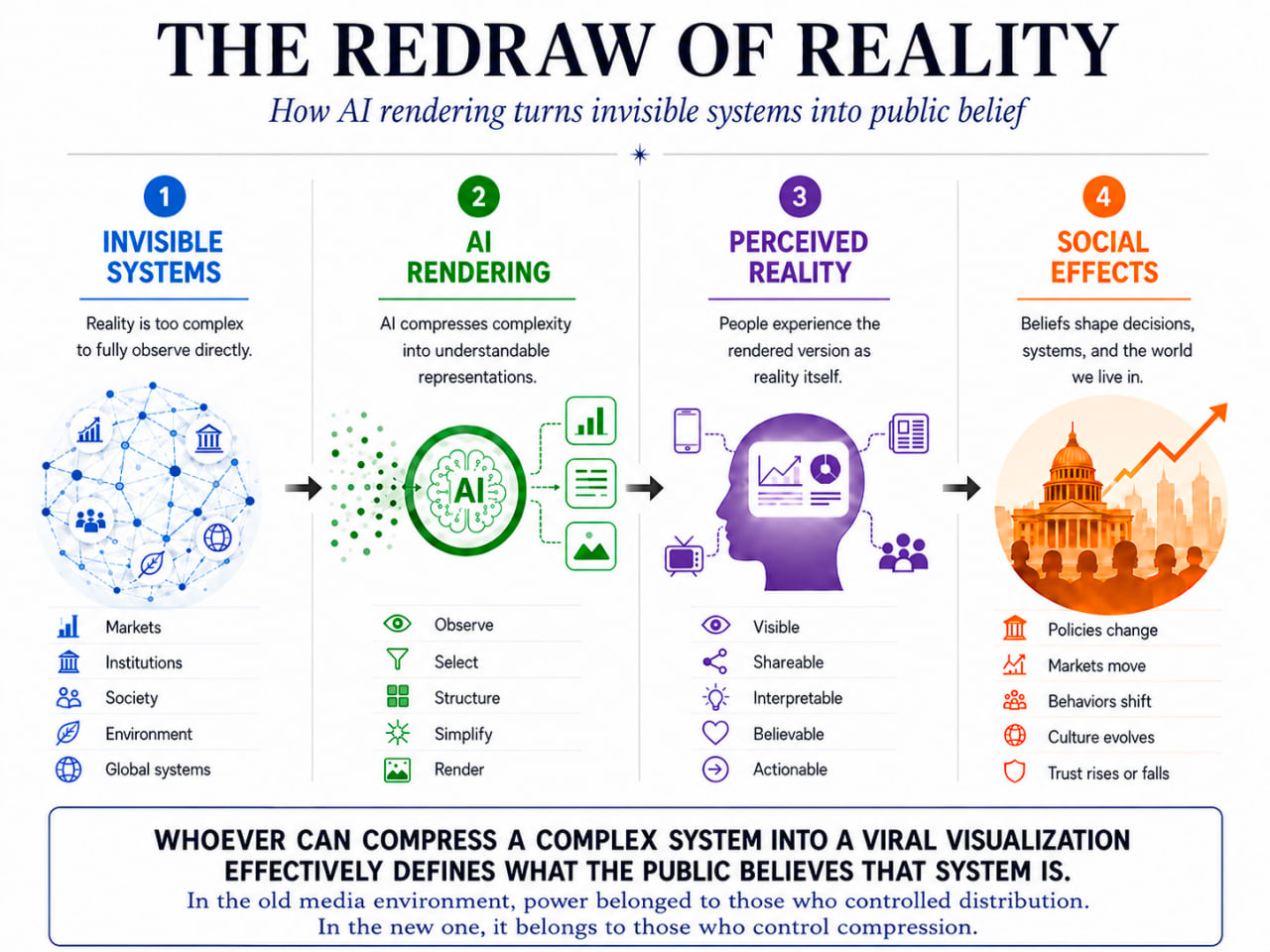
Visualization plus memetics is the new shape of public power. The image and the meme together do what speeches and op-eds used to do, faster, cheaper, and more emotionally direct. The most influential political communicators are increasingly not the ones with the best speeches or the best policies. They are the ones with the most compelling renderings of complex systems, and the ones whose slogans carry the superior memetic fitness. The ones who can compress, not lecture. In the old media environment, power belonged to those who controlled distribution. In the new one, it belongs to those who control compression.
I have watched this dynamic play out in real time. I was early to one of the most successful memetic assets in crypto, and I watched a compressed image move at the speed of the feed and outrun every framework built to price it. Citing that in a paper arguing for substrate over narrative looks like a contradiction, but it is the whole point. I saw, from the inside, how completely narrative can detach from production and still command a price. That is exactly how I learned to value the thing underneath. That detachment does not make the price fake. It makes it powerful, unstable, and dangerous to misunderstand. When the music stops, you want to own the thing the memes point to, not only the meme itself. I am writing about substrate now because I have seen what the alternative is made of.
There is a second reason to watch memes, and it has nothing to do with trading them. A meme is a signal. It is where a shift in what people believe becomes visible before it shows up in prices, in politics, or in institutions. By the time a change is legible in the official numbers, it has usually been alive in the memes for a while. The same way capital follows talent on a lag, the slow systems follow the memes on a lag. Reading them is not frivolous. It is one of the earliest available reads on what is about to move.
The financial consequences are the early signal. The political ones are coming. The dynamic does not stop at markets and politics. Science communication, cultural memory, military narrative, geopolitical perception, supply chains, public health, and the framing of any large complex system are all subject to the same selection pressure. The same compression that turns an image into a multi-billion-dollar digital asset can turn an image into a movement, a policy outcome, or an election result. The mechanics that built the last decade of memetic assets will increasingly build political reality. Whoever masters them wields a form of power that legacy institutions are not equipped to counter and have not yet taken seriously.
The Double Edge
What I have been describing has a double edge, and it is sharp on both sides.
On the bright side, we are inside the largest democratization of structural knowledge in human history. The complexity of the world, which has been opaque to most people for the entirety of civilization, is becoming legible. Public understanding of disease, environment, economics, and infrastructure is going to deepen at speeds that have no precedent. Decisions made in ignorance for centuries are going to be made with more grounded mental models. This is profoundly good.
On the dark side, the same tools enable the most powerful propaganda apparatus ever assembled. A visualization does not need to be true to be persuasive. It only needs to be compelling. AI can produce compelling visualizations of false claims as easily as true ones. Political actors, foreign and domestic, are flooding the discourse with weaponized renderings of demographic flows, economic outcomes, cultural changes, and historical events that may bear no relation to actual data. The visualizations will travel faster than corrections. The corrections will be less compelling than the originals.
The cumulative effect is a media environment in which what people “see” diverges from what is actually happening, in directions chosen by whoever owns the rendering capacity.
This dynamic feeds the Coalition of Fear directly. People who already feel afraid are being shown more compelling, more immersive, more emotionally devastating versions of what they fear. The fear is being cultivated by actors who understand exactly what they are doing. Some of those actors are foreign. Some are domestic. Some are not actors at all but algorithms optimizing for engagement without regard to consequence.
We are going to spend the next decade trying to figure out how to live with this. The current generation of platforms, regulators, and journalists is not equipped for it. The volume and quality of synthetic visualization is climbing a curve that legacy verification cannot match.
Notice the Redraw
The reality you are operating in is being rewritten in real time by the rendering capacity of intelligent systems. Some of what you “know” about the world in five years, you will know because you saw it in an AI-generated visualization that compressed something previously invisible into something memorable. Some of it will be true. Some will not. The discipline of distinguishing the two is going to become one of the most important cognitive skills of the coming decade. The response is not to reject visualization. It is to demand the kind that is source-linked, auditable, and grounded in real data, and to distrust the kind that is not.
There is a layer beneath opinion and narrative. Call it the ontological layer: the set of things a person takes to exist and to be true. For all of history it was shaped by what we could directly perceive. Now it is shaped by what gets rendered. That is the deepest level of what is being redrawn, and it is why this matters more than the word “misinformation” can carry. Misinformation is a wrong fact inside a shared reality. This is the editing of the reality itself.
The map of reality is being redrawn. Most people will live inside the new map without noticing the redraw happened. The ones who notice will be in a position to act on the rendering rather than be acted on by it.
The redraw is already underway.
Notice it.
XII. The Ascent
I am not going to end on the unrest. That would be dishonest, because it is not where I think this is going.
This is where the paper changes register. Some of what follows is base case. Some is aggressive case. Some is what I called earlier the mythic horizon: claims that are not investable today but follow logically from the trajectory and that I believe will look obvious in retrospect. They live in this chapter because this chapter is where the paper moves from forecast to interpretation.
Nothing in the investment thesis requires the mythic horizon to arrive on schedule, or at all. The core trade lives in the bottlenecks. But the reason I am writing this paper, and the reason I am building a public identity around the worldview it describes, is the long arc this chapter tries to name. This is the part that matters most to me.
What I see, when I zoom out far enough, is not a story of decline. It is a story of expansion. The longest arc of the human experience, taken across millennia, is one of expanding capability, expanding knowledge, expanding energy, and expanding reach. Not evenly. Not cleanly. Not with any moral guarantee. There have been collapses, dark centuries, and reversals. But across long enough timeframes, the species learns more, builds more, coordinates more, and extends farther.
Consider what we are about to do.
We are encoding the scientific and technological knowledge of our species into systems that can reason with it, recombine it, and generate new knowledge from it at speeds we have never had access to. The pace of scientific discovery is accelerating substantially. A growing share of disease will become legible, targetable, and eventually preventable or reversible as AI-driven biology compounds.
The long-run direction is energy abundance. Not merely cheaper energy. Not permanently subsidized energy. Abundant energy. Once we get past the bottleneck of the next ten years, the curves on solar, geothermal, advanced fission, and eventually fusion intersect with the curves on AI-driven manufacturing efficiency, and energy starts behaving less like a permanently scarce commodity and more like a compounding technology curve. That changes everything downstream. Heavy industry that has been carbon-bound for a century becomes cheaper. The compute layer expands without the energy ceiling that currently caps it.
Mythic horizon: the energy budget does not stop at the planet's surface. As launch costs collapse and in-space manufacturing matures, harvesting solar energy directly in orbit, where there is no night and no atmosphere, stops being science fiction and becomes an engineering and cost problem. This is the literal version of climbing the Kardashev scale, and it is the point where the energy thesis and the space thesis become one. Far dated, and I am not pricing it. But it is the logical end of the same curve.
There is a climate corollary here, and most of the mainstream conversation about it has the causality backwards.
The dominant frame is that civilization is destroying the planet and the only fix is to consume less, build less, and accept a permanently smaller life. That is the degrowth frame. The limits it points at are real; the prescription is backwards. Degrowth looks at real constraints and concludes the answer is less, when progress has always come from building past them. It is wrong on the economics, and it teaches a generation to fear the future instead of building it. You do not reach a richer, cleaner world by doing less. You reach it by building more of the right things.
Emissions are not a sin to atone for. They are a byproduct of energy that is still too scarce and too dirty at the margin. Fix the supply and the byproduct declines as the marginal unit gets cleaner, without requiring civilization to reorganize itself around guilt. That is not a hope. It is already in the cost curves. The levelized cost of utility-scale solar has fallen roughly 90 percent since 2010, with onshore wind and battery storage on similar trajectories. By 2024, per IRENA, 91 percent of newly commissioned utility-scale renewable capacity was already cheaper than the cheapest new fossil alternative. There is a tension worth naming, since I lean on the opposite dynamic elsewhere: cheaper energy tends to raise total consumption, not lower it. This was never a story about using less. It is a story about what the marginal new unit of energy is made of, and as clean generation becomes the cheapest source, it wins the new build and outcompetes dirty capacity on cost rather than on mandate. The buildout this paper describes is the same buildout that pushes emissions down. Not as a goal. As an output.
The cultural fight over this will last longer than the engineering fight. The engineering is mostly a question of building fast enough. The fight is over a worldview that treats human activity as the problem rather than the source of the solution. The “humanity versus nature” framing that has organized environmental thought for fifty years is going to look as dated as the Earth-centered cosmos. Humans are not the planet’s disease. We are the part of it that builds, and building is what gets us off it.
Which is the real point. The same energy abundance that settles the carbon question on Earth is what opens the next frontier off it. We are the planet becoming conscious of itself, building the tools to extend itself, beginning the long expansion outward. Farther out: engineered ecosystems on the Moon, controlled-atmosphere habitats in orbit, eventually terraformed surface on Mars. Biospheres we build rather than only the one we inherited. Earth is the first. It will not be the last.
The acceleration this paper describes is, on net, life-extending and life-creating. The medical breakthroughs coming are real, and the first generation to benefit seriously from longevity science is alive today.
Mythic horizon: AI compresses drug discovery and tailors molecules to individual genomes, while autonomous machines operate at cellular scale to repair, target, and engineer biology directly. The biology of aging and repair becomes something engineers operate on rather than something doctors negotiate with.
My larger view is that we are about to take the species off-planet. Not as a stunt. Not as a science project. As an actual expansion. The aggressive case is that by the time the children being born today are middle-aged, there will be a meaningful permanent presence on the Moon and the early stages of one on Mars. The mythic-horizon case is that our descendants will look back at the late twentieth century the way we look back at the time before the New World was reached: as a smaller, more provincial era. This is what a civilization that keeps expanding its energy budget eventually does. You cannot do it without leaving the planet. The path is uncertain. The trajectory is not.
When you stack five or six exponentials together (compute, algorithms, energy, robotics, AI, biology), the result does not behave like an exponential. The rate of change can exceed the capacity of human institutions to adapt and the capacity of human minds to plan. Some call this the Singularity. It is a regime, not a moment. The right posture inside it is not panic. It is stewardship.
Mythic horizon: human cognition itself stops being fixed. Not metaphorically. Direct interfaces, augmentation, and tight coupling with machine intelligence turn individual intelligence into something expandable rather than inherited. The line between using a tool and extending the mind blurs.
Underneath all of this, we are going to confront the question of what we are. Not as nationalities. Not as professions. As a species.
We are becoming a civilization that builds minds, habitats, and production systems beyond the limits of inherited biology and geography. That is strange enough. It does not need mystical language to be profound.
That is the actual story.
If you can hold that story in mind while you read the daily news, the daily news stops being terrifying. The same churn of fear, greed, status, conflict, and confusion that has accompanied every other moment of our species’ development. Loud, but shallow. Dramatic, but local.
Technology itself is not the final moral category. Capability is. The problem is fit: whether what we build actually serves what is good for us. Every transition humans have lived through has produced the same primal fear, that the new tool will destroy what makes us human, and every transition has eventually been metabolized into a deeper expression of what makes us human. We are early in this one. Early in the curve always feels existential. Stewardship, in the broadest sense, is the frontier we are working on now: technical, institutional, political, and moral. It will take time. It may get worse before it gets better. The pattern is not that humans solve every transition quickly or cleanly. They do not. The pattern is that the tools that survive are eventually metabolized into the human project and become part of how the species extends itself.
The deep current is not the daily unrest. The deep current is capability.
A recession can change the path. A war can change the path. A regulatory crackdown can change the path. A generation that does not understand what is happening can change the path. Those things decide who leads, who captures the value, who adapts, who suffers, and who gets left behind.
They do not erase the underlying direction.
This is what I mean by the Ascent.
Not paradise. Not prophecy. Not a spiritual exemption from bad decisions. The Ascent is the transition from a civilization constrained by human labor, scarce and dirty energy, fragile money, and one planet into one increasingly shaped by abundant intelligence, automated production, expanding energy, and frontier infrastructure.
That is what I see.
That is why I am invested. Financially, yes. But not only financially.
The point is not to stare at the future in awe. The point is to participate in building it.
XIII. The Bets
A worldview that never states what it expects is just vibes. So here are the directional calls I am willing to put my name to. These are convictions I would defend at a dinner table, stated in plain direction and rough timeframes rather than precise thresholds. I am not pretending these are falsifiable to the decimal. They are the things I actually believe will happen, stated clearly enough that you can watch them play out and judge the direction for yourself.
The Bets
Deliverable power will be the true bottleneck of the AI decade. The market is still treating intelligence as the scarce asset. I think that is backwards. Intelligence is becoming abundant; deliverable power is not. The constraint is the physical substrate: electrons, uranium, gas, copper, transformers, turbines, switchgear, transmission, substations, and interconnection agreements.
AI agents will autonomously execute multi-day, multi-step work at the level of a competent human professional within the next few years. Not chatbots. Not assistants. Autonomous workers running real research, real analysis, real software engineering, real operations, with humans acting as supervisors rather than executors.
Edge AI, the compute that runs locally on devices, robots, and infrastructure rather than in the cloud, will become a structurally large category that is currently underpriced relative to where it is going. The cloud-AI giants dominate the current narrative. The on-device layer is harder, less covered, and is the only path to the latency, autonomy, and reliability that humanoid robots, autonomous vehicles, defense platforms, and ambient computing require.
The market will increasingly price leading models as platforms, not products. The model is becoming the operating system the software stack runs against, the way Windows and iOS became the layers everything else depended on. The value accrues to whoever owns that layer, not to any single app on top of it. And the infrastructure software every AI system needs to run, the security, observability, and networking layer, is part of that substrate too, not the disposable application layer. The market is still counting apps and users rather than pricing the platform and infrastructure underneath them. That is the mispricing.
Robotics will move from research curiosity to commercial deployment at scale this decade, and the deployment curve will inflect in the 2030s. Humanoid platforms move into warehouses and logistics first, then increasingly into services. The exact penetration percentage is less important than the direction: pilots become production deployments, production deployments generate data, and the data accelerates the next generation. By the time the Bottleneck Decade closes, the obviousness of this trajectory will look like the obviousness of smartphones in 2016.
Biotech and longevity, currently far less priced in than AI or robotics, will become one of the largest categories of value creation on the road to 2045. AI is collapsing the discovery cycle for drugs, therapies, and diagnostics. Cellular reprogramming, gene editing, and aging biology are converging into a real engineering discipline rather than a research curiosity. The buildout is real, the capital and talent are flowing in, and the repricing has not happened yet.
Automation will materially displace labor across white-collar and blue-collar work over the road to 2045. Mental labor first, physical labor second. The pyramid of professional work that organized the postwar economy is being structurally inverted. The first wave is already underway through hiring freezes and silent productivity gains rather than visible layoffs.
The median real income for new graduates of non-elite universities will decline in real terms over the rest of this decade. This is the specific population that loses bargaining power earliest and most visibly.
Major technology companies will dramatically improve revenue and profit per employee over the next decade. Headcount will drop or stay flat while output expands. The most public-facing examples will come from software, finance, and media, where AI absorbs the work first. The companies that signal this transition explicitly will see their multiples re-rate. The ones that hide it will get re-rated anyway.
Gold will be worth materially more in the future, in both nominal and real terms. I will not put a price target on it. The structural drivers of monetary debasement, central bank accumulation, fiscal dominance, and dollar erosion are permanent features of the system, not transient. The move is not done. It is mid-cycle.
At least one G7 nation will face a sovereign debt crisis on the road to 2045. I mean an event requiring emergency central-bank intervention, yield suppression, auction support, liquidity facilities, or other extraordinary stabilization measures. The math does not work without it.
Defense spending in NATO countries will be structurally elevated for decades and will not return to pre-2024 levels. Frontier defense companies will outperform legacy primes. Procurement budgets will increasingly favor software-first, drone-first, autonomy-first platforms.
Taiwan will remain the single most strategically contested territory on Earth until US semiconductor manufacturing scales meaningfully, which likely will not happen before 2030 at the earliest. Until then, the concentration is a tail risk every major capital is forced to price. I do not foresee military resolution. The economic interdependence between the US and China keeps the cost of real conflict prohibitive for both sides, and the modern version of MAD includes supply chains, not just nuclear weapons.
Frontier technology infrastructure will be reclassified as national security infrastructure. Data centers, foundation model labs, robotics manufacturing, critical mineral processing, and launch capacity will be protected, subsidized, regulated, and in some cases directly defended in ways that look closer to defense procurement than to ordinary commercial activity.
The space economy will expand from a still-emerging sector today into one of the most important industries of the global economy on the road to 2045. Launch costs will keep falling. Constellation infrastructure will become the dominant communications and sensing layer. Defense spending and commercial demand will both drive the buildout, and orbital compute and manufacturing will move from research to commercial production. The largest pools of public and private capital are already moving.
Launch cadence and orbital infrastructure will become the binding constraint on the space economy, the way deliverable power is the binding constraint on AI. The demand for orbit, for constellations, sensing, in-space manufacturing, and eventually orbital compute, is inflecting faster than the supply of reliable, high-cadence, reusable launch can grow. The bottleneck is not the idea. It is the physical capacity to put mass into orbit on schedule, and the infrastructure to do anything with it once it is there. The same supply-chain physics that gates the terrestrial buildout, long lead times, concentrated capacity, inputs that cannot be conjured on demand, is coming for space. Whoever owns the launch and orbital-infrastructure layer prices everything above them in the stack.
I am very confident about the direction of the cluster. If even half of these prove right, the structural trades that follow become difficult to ignore.
What Would Make Me Reconsider
Conviction does not mean pretending nothing can go wrong. The direction of this thesis is clear to me. The path is not. These are the things that would make me update, resize, or change the way I express the trade.
Politics could change the geography and pace of the buildout. Aggressive taxation of AI productivity gains, heavy-handed regulation, AI moratoriums in major jurisdictions, populist backlash that makes capital flight politically expensive, or sustained pressure to slow deployment in the name of safety could turn the Bottleneck Decade into a Bottleneck Generation. Backlash probably does not stop the stack globally, but it can stop it locally. The future still arrives, just not evenly, and the countries that get this wrong politically will be poorer because of it.
AI could disappoint at the frontier. Scaling could slow, reasoning could plateau, inference costs could stay too high, or regulation could concentrate the market into a small number of approved providers.
Robotics could take longer than I expect. Unstructured real-world environments are hard. Hardware scales slower than software. Humanoids could follow the self-driving car path: directionally right, but slower and messier than the early bulls wanted.
Energy could become a timing problem. The strongest bear case is not that AI fails. It is that the physical world cannot build fast enough. Interconnection delays, transformer shortages, copper supply, permitting, land fights, water fights, and local politics could stretch the bottleneck from a decade into a generation.
Biotech could stay bottlenecked by clinical reality. AI can accelerate discovery, but trials, regulation, biology, and human safety still move slowly. Longevity could be real and still take longer than markets want.
The monetary bear case could be early for longer than expected. Markets can tolerate bad fiscal math for a very long time. AI-driven productivity could extend the runway and delay the debt problem.
None of these break the destination for me. They change the path, the speed, and the correct sizing. That matters. Being early to the right future can still be expensive if you size the trade like the future arrives tomorrow.
These are not bear cases from people who hate the future. These are the risks I actually care about, because they would change the timing, sizing, or expression of the trade. That is the wager. I am putting it in writing so I can be held to it.
XIV. The Trade and the Hold
This is where the thesis becomes a position.
The four frontiers are the four domains where civilization is genuinely expanding. Everything else in the modern economy is downstream of them, supporting them, processing their outputs, or being reorganized by their consequences.
The four are: AI. Robotics. Energy. Space. Defense is the fifth section below, but it is not a frontier in the same sense. It is the envelope, the state’s demand function running across the other four, and it is investable as its own layer.
I am going to walk through each one with the same structure: what the trade is, why it works, what the time horizon looks like, and what the risks are. I am not going to give you tickers. Tickers are perishable. The frame is durable.
1. AI
The trade: ownership of the compute, the models, the platforms, and selected application-layer winners of artificial intelligence as it transitions from a product category into the substrate of the global economy.
Why it works: intelligence is the most general-purpose input there is. Increasing its supply increases the supply of everything else. The companies that own the means of producing it will capture an unusually large share of total economic value.
Time horizon: ten to twenty years for the structural buildout. The next three to five years will determine the architecture and the winners. The decade after that will compound the moats.
Where to look: the cleanest exposure is the compute and energy substrate, not the application layer. Everyone is racing to build the next model. Own what they all need. The application layer will produce winners, but picking them this early is closer to venture than to position trading.
Risks: regulatory capture, scaling plateaus, or reasoning stalls at the frontier.
2. Robotics
The trade: ownership of the companies that bring artificial intelligence into physical embodiment, both general-purpose humanoid platforms and specialized industrial systems.
Why it works: the same intelligence automating mental labor is, with a different deployment pattern, automating physical labor. Most of GDP is still moved by hands and tools. When that labor cost collapses, the productivity unlock is on the order of the original Industrial Revolution, but compressed.
Time horizon: the technology is at an inflection. Real commercial deployment in industrial settings is happening now and accelerating. Real consumer deployment comes later, after industrial and logistics use cases prove reliability, cost, and safety. The full economic impact plays out over the next two decades.
Where to look: the trade right now is the actuators, the batteries, and edge AI, the compute that runs locally on the robot rather than in the cloud. Everyone is racing to build the humanoid. Almost nobody is building the parts those humanoids cannot run without. The component layer is harder to commoditize than the integrated platform. Components first. Platforms later.
Risks: the bottleneck is hardware cost, actuators, the capital to manufacture physical units at scale, and regulation.
3. Energy
The trade: ownership of the generation, transmission, and resource layers of the global energy transition, with particular weighting toward nuclear, transmission infrastructure, and the critical commodities supply chain.
Why it works: the rest of the thesis cannot exist without it. AI cannot run without electricity. Robotics cannot run without electricity. Space industrialization cannot run without electricity. The grid as currently constructed cannot deliver what the next twenty years require.
This is not a narrow commodity thesis. It is a long energy-expansion thesis. More nuclear. More gas. More geothermal. More solar. More storage. More transmission. More transformers. More copper. More uranium. More everything that turns physical energy into usable industrial power. The ideological fight over which source “wins” is less important than the structural fact that civilization is going to need vastly more power, delivered faster than the current system can build it.
Time horizon: twenty to thirty years for the full buildout. The critical bottleneck phase, where supply cannot keep up with demand and prices reflect that, is the next ten.
Where to look: the highest-conviction commodity expression is uranium. Concentrated supply, AI-driven demand inflection, Western processing capacity that does not exist at the required scale. After that, the underrated trade is the grid itself: transformers, switchgear, transmission. Everyone talks about generation. The bottleneck is delivery. Gold sits beside these as the monetary hedge, not as part of the energy trade.
Risks: the physical buildout is the bottleneck. Interconnection queues, transformers, and permitting can stretch the timeline for years.
4. Space
The trade: ownership of the launch infrastructure, orbital infrastructure, and emerging space industrial economy as cost-of-access continues to fall and the addressable market expands by an order of magnitude.
Why it works: the foundational economics changed with reusability and are about to change again with full reusability of larger vehicles. When access costs fall by another factor of ten, entire categories of business become viable.
Time horizon: the launch and constellation layer is already monetizing. The orbital industry layer is early but real. The deep space resource and settlement layer is a 2040s story and beyond.
Where to look: launch is the toll road. Whoever owns reliable, reusable launch prices everything above them in the stack. After launch, the constellation operators with structural advantages compound for decades. Everything else in space is downstream of those two layers.
Risks: the orbital economy may not materialize fast enough, and regulation, spectrum fights, and orbital congestion can slow the whole layer down.
5. Defense, the Envelope
The trade: ownership of the new generation of defense-tech companies that are software-first, autonomy-first, and manufacturable at scale, alongside selected exposure to the legacy primes that are repositioning.
Defense is not a frontier the way the other four are. It is the envelope around them, the state’s demand function expressed as procurement, and it becomes investable wherever that demand lands on a company building autonomy, drones, or munitions. You are not betting on a separate sector. You are betting on the state’s demand curve running across robotics, AI, and space, and on which companies capture it.
Why it works: geopolitical fragmentation is a permanent condition for the next two decades. Defense budgets are structurally rising in most major economies. The character of warfare has changed. The procurement budget has not fully reflected that yet, but it is starting to, and companies building for the new character of warfare are capturing an outsized share.
Time horizon: the procurement reorientation is a five-to-ten year process. The full impact on company valuations is a fifteen-to-twenty year story.
Where to look: the trade is the new generation of defense-tech, the companies building autonomous systems, drones, and AI-enabled command and control for the actual character of modern conflict. Most legacy primes are not the trade. They are the incumbents that the new entrants are competing with. And remember who sets the price: a pure procurement-only customer base is the coupon, not the compounder. The munitions layer, a structurally short-capacity category that almost nobody is exposed to and almost everyone will need, is the cleanest expression.
Risks: sustained budget pressure or a major de-escalation breaks the structural-spending premise the trade depends on.
Selection, Sizing, Valuation
No tickers does not mean no discipline. The frontier being right is not the same as the company being right, the price being right, or the position size being right. All four have to clear.
The way to own this is not to buy every company with the right nouns in the deck. It is to separate the frontier from the implementation. The frontier can be right while individual companies fail. The theme can compound while early leaders get diluted, regulated, outcompeted, or repriced. Selection matters. Sizing matters. Valuation matters. Cash flows matter eventually.
One more thing, said plainly. None of these four frontiers are contrarian. Power as the bottleneck, uranium, copper, defense-tech, robotics, the substrate-over-application trade: these are among the most discussed themes of the mid-2020s, and if you came here looking for a secret name nobody else has found, I do not have one. The edge was never in the discovery. It is in the duration, the sizing, and the willingness to hold a known thing through the volatility that shakes most people out of it. Most investors can identify the right trend. Far fewer can sit in it for a decade without flinching. The alpha is in the holding, not the knowing.
My framework is simple: own the platforms where possible, own the bottlenecks where the platforms are not accessible, size speculative right-tail exposure small enough to survive being wrong, and keep enough liquidity to add when the hype cycle throws away the babies with the bathwater.
How To Hold
These are not equal-weighted ideas. Size them around your actual stomach, not your fantasy risk tolerance. Within each frontier, the winners will rotate. Your job is to keep selecting forward, reweighting toward where the actual progress is happening, cutting positions that have stopped compounding, and adding to positions early in their curves.
The most important skill is not prediction. It is selection. And patience.
There is a deeper reason selection matters this much. Outcomes in frontier markets follow power laws, not bell curves. A small fraction of names captures the overwhelming majority of the returns. This is the Pareto principle, and it is closer to a law of complex systems than a tendency. It means owning the average gets you the average, which in a power-law distribution is a fraction of what the top captures. The entire game is being concentrated in the right exposure and holding it. But concentration is only an edge if the selection is real and the sizing lets you survive being wrong.
My number one rule on markets, after all the years of trading them, is this:
You are going to make your money the way money has always been made: by compounding a structural trend over a long time.
Not by predicting the top. Not by trading around it. Not by being clever. By picking the right structural trend, getting positioned in it, and refusing to let go for as long as the underlying thesis is intact.
Look at one of the clearest case studies of the last decade. Crypto.
Who actually made transformative money in crypto? Not the people who were early to Bitcoin. Being early was necessary. It was not sufficient.
The people who made generational money in Bitcoin were the ones who were both early AND held on for over a decade. Through 80% drawdowns. Through 90% drawdowns. Through bear markets that looked, from inside them, like terminal failure. Through entire cycles where the thesis was declared dead by people who sounded smarter than the holders.
Most early people sold. They captured a 5x. A 10x. They felt smart. Then they watched the thing they sold go up 100x more.
The hold was the alpha. The conviction was the alpha. The willingness to look insane while the rest of the market was screaming at you to abandon the position.
Survivorship bias is real, and it is the strongest argument against everything I just said. For every Bitcoin, a dozen “obvious structural plays” went to zero, and the people holding them through the drawdown felt exactly as righteous as the Bitcoin holders did. Conviction feels identical whether you are right or wrong. That is the whole problem. Selection happens after the fact. The “hold forever” advice only works if you picked the right thing to hold, and you cannot know in advance which group you are in. Picking is the harder problem than holding. Conviction without falsification criteria is just stubbornness and ego.
I have been down 80% on positions I knew were right. I have also been down 80% on positions I thought were right and turned out to be wrong. The thing nobody tells you is that those two situations feel identical from the inside. Conviction does not feel like conviction at the bottom. It feels like stupidity. It feels like everyone else has figured something out you missed. Your body produces adrenaline as if you were physically unsafe.
The honest version of The Hold is this: you cannot know in real time which kind of drawdown you are inside. The structural one that resolves to a 100x. Or the broken-thesis one that resolves to zero. The hold is not about being certain you are right. The hold is about having done the structural work in advance, sized the position to your actual stomach, and built in falsification criteria you will respect when they trigger.
Trading is a mirror. Whatever is unresolved inside you, the market will find it. The trader who has not made peace with greed will overtrade. The trader who has not made peace with fear will sell bottoms. The trader who has not made peace with their own ego will average down on broken theses to avoid being wrong. The market does not punish you for being wrong. It punishes you for being unwilling to look at yourself. Every position you hold is showing you something about who you are. The traders who last are the ones who learn to read the reflection and adjust the person, not the position.
One thing I wish someone had told me when I started: your biggest risk is not the market. It is not the news. It is not the macro. It is your own nervous system. Every other risk in this chapter is fundamentally a nervous-system event with a financial label attached. I have lost more money to my own panic than to any thesis being wrong. The traders who survive long enough to compound are not the smartest. They are the ones who learned to operate with their hands shaking and act anyway.
There is a pattern worth naming here. Call it the horseshoe theory of markets. The retail trader who buys Nvidia because “AI seems cool” and holds for ten years ends up in roughly the same place as the institutional investor who built a sophisticated thesis, accumulated carefully, and held for ten years. Both look like geniuses in retrospect. Both looked like idiots at various points along the way.
The person who gets destroyed is in the middle. The slightly-informed investor who reads finance Twitter, watches CNBC, follows three economic indicators, and trades on partial knowledge. They are smart enough to be active and not smart enough to be right. They get chopped to pieces by their own awareness.
The dumb hold and the genius hold look identical from the outside. The fool and the savant arrived at the same position by different routes, and both were rewarded by the structural curve. The middle understood just enough to talk themselves out of it.
The lesson is uncomfortable: in a market where structural curves dominate, partial knowledge is more dangerous than no knowledge. If you are not going to do the deep work, do less work, not more. Pick the exposure. Let it compound. Stay out of your own way.
Somewhere on the road to 2045, there will be a 2008-style dislocation. Maybe sovereign debt. Maybe a black swan nobody is currently modeling. The headlines will be terrifying. Most traders will sell. Some investors will hold. An even smaller number will buy. The greatest opportunities of the decade come from the moments most people are too afraid to take.
A version of the same lesson applies inside the frontier sectors. At some point, the AI and robotics complex will get called a bubble. The dot-com comparison is everywhere. Trapped holders will sell every rally trying to escape. That is often where bottoms start to form. Capitulation eventually births conviction. The dot-com bust did not kill the internet. It cleared the field for the platforms that compounded for the next twenty years. The AI bubble will not kill AI. It will do the same.
These are not three-year trades. They are multi-decade structural expansions. The dirty secret is that the largest cumulative returns are not made at the peak. They are made on the long climb up, when the technology is actually working and most observers have stopped paying attention. Treat any of these as a swing trade and you will be a tourist, out by year five, right before the part that matters.
The day-to-day candles do not contain signal at this scale. They contain an actively engineered emotional payload, designed to keep you reactive and trading. If you cannot remain emotionally stable through a 60% drawdown, you will not capture a 100x. The algorithm will help you leave on schedule.
So here is the alpha that nobody talks about, the one that took me years to internalize:
Knowing when not to open the portfolio is real alpha.
Not forever. Not as denial. Not as avoidance. But for specific windows, when the noise is at maximum and your thesis is intact, the most powerful action you can take is to stop looking. Close the app, go outside, touch grass. Trust the thesis and the position, and come back next quarter.
The people who can do this are rare. They are also the ones who end up on the right side of the chart in a decade.
What I have given you is a thesis I have conviction in. The destination is the most likely structural outcome. The path and speed are debatable, and that debate is most of what the noise is. Hold the destination. Tolerate the path.
Pick the frontier. Take the position. Hold it like you held it in your imagination when you first read this paper. Many things outside the four frontiers will go to zero. Many things inside them will too. Many things inside them will go parabolic. The dispersion is the trade. The Hold is the trade. Patience is a position.
Signals to Watch
If this thesis is going to be useful beyond the day it is published, the question becomes: how would you know whether it is working?
This is the scoreboard: the indicators per frontier that tell you whether the buildout is on track, accelerating, or stalling.
If most of these indicators move in the directions implied by the chapters, the thesis is intact. If many of them stall or reverse, go back to What Would Make Me Reconsider and ask whether the thesis is wrong, early, or simply expressing itself somewhere else.
Intelligence. Frontier model capability on extended-horizon tasks. Inference cost per million tokens. Enterprise adoption of agentic systems. Share of new commercial code authored or co-authored by AI. Capex commitments by hyperscalers and sovereigns. Power purchase agreements for AI training runs. Number of nation-states with serious domestic compute strategies.
Robotics. Humanoid units deployed in commercial settings. Cost per humanoid unit. Robot-hour cost vs human-hour cost in target tasks. Warehouse and factory penetration rates. Component cost curves on actuators, sensors, and batteries. Real-world deployment data published by leading platforms.
Energy and Materials. Data center electricity demand. Grid interconnection queues. Transformer lead times. Nuclear restarts and new builds. Small modular reactor licensing milestones. Copper, uranium, lithium, and rare earth contract pricing. Hyperscaler energy purchase agreements. Critical minerals reshoring progress. Clean energy capacity additions. Fusion milestones from leading labs.
Space. Launch cadence and payload mass to orbit. Reusability cycle counts. Cost per kilogram to LEO and GTO. SpaceX revenue, valuation, and public market debut. Constellation operator revenues. Orbital manufacturing first commercial outputs. Lunar infrastructure contracts. National space-domain awareness investments.
Defense and the National Security Stack. New entrant defense-tech contract wins versus legacy primes. Drone and counter-drone procurement. Autonomy and AI-for-defense pure-play growth. NATO and allied defense spending as share of GDP. Munitions production capacity. Strategic asset designations applied to AI, robotics, and energy companies. Export control expansions. Data center security and physical hardening visible in public filings.
Money. Federal Reserve balance sheet. U.S. federal debt and debt service ratio. Central bank gold purchases. Non-dollar settlement volumes through BRICS-aligned rails. Treasury auction coverage ratios. Real yields on long-duration sovereign debt.
Empire and the National Security Stack. Cross-bloc duplication of frontier industrial capacity. Allied versus rival capex on AI, robotics, energy, and space. Visible erosion or reinforcement of dollar reserve status. Geopolitical events around Taiwan, the Gulf, the Arctic, and Sub-Saharan resource zones.
Labor and Capitalism. Entry-level hiring rates in software, law, finance, consulting, design. Revenue per employee at large enterprises. Real income trajectories for non-elite graduates. Wage premiums on professional credentials. Political emergence of technology-driven labor displacement platforms, with AI and robotics as the visible targets. Early experiments with sovereign wealth, birthright investment accounts, citizen ownership, direct transfers, or tokenized national equity.
Coalition of Fear and the Redraw. Polling on sentiment toward technological acceleration, especially AI, by faction and demographic. Physical or legal action against AI, data center, robotics, and energy infrastructure. Quality and reach of synthetic visualizations in political discourse. Verification infrastructure investment and adoption. Media literacy and informational hygiene metrics, where they exist.
Ascent Indicators. Pace of disease-specific drug discovery using AI. Lifespan-extension interventions reaching commercial availability. Off-Earth permanent presence. First commercial fusion power on the grid. First commercial orbital compute deployments. First serious steps toward capturing solar energy in space, where the vast majority of the sun's output still goes uncaptured. First serious mainstream use of “the singularity” as a non-fringe term in financial commentary or political speech.
Treat this as the scoreboard. If the thesis is right, the signals move with the chapters. If it is wrong, you will see it here first.
Selected Sources
These are the receipts for the numbers people are most likely to attack. This is not an academic bibliography. It is where the numbers come from.
AI and compute. Stanford HAI, Artificial Intelligence Index Report 2026 for capability benchmarks and model trajectories. METR research (2024-2025) on agent task duration scaling. Epoch AI for compute scaling and frontier training run analysis. Hyperscaler 10-K filings and earnings transcripts for capex disclosure.
Energy and data centers. International Energy Agency, Energy and AI (April 2025) for data center electricity demand projections of approximately 945 TWh globally by 2030 (up from 415 TWh in 2024) and U.S. data center demand growth of approximately 130% from 2024 levels. IEA World Energy Outlook 2025. Lawrence Berkeley National Laboratory, 2024 United States Data Center Energy Usage Report for U.S. data center energy use projections. Lawrence Berkeley National Laboratory, Queued Up interconnection queue data for active generation and storage waiting to connect to the U.S. grid. EIA for grid generation mix. Regional grid operator (PJM, ERCOT) interconnection queue data. Wood Mackenzie Q2 2025 transmission and distribution supply-chain survey for transformer and grid-equipment lead times (large power transformers averaging 128 weeks, generator step-up units 143 to 144 weeks). Reuters reporting on grid equipment shortages and hyperscaler transmission bottlenecks.
Copper and critical minerals. International Energy Agency, Global Critical Minerals Outlook 2025 (May 2025) for the 30% projected copper supply deficit by 2035 under STEPS scenario, the 17-year average copper mine development timeline, and the 40% projected lithium deficit by 2035. S&P Global Market Intelligence (December 2025 reporting on the IEA UK summit) for export control proliferation in 2025. London Metal Exchange for spot pricing.
Gold and money. World Gold Council, Gold Demand Trends Full Year 2025 (published January 29, 2026) for the 863.3 tonnes of central bank gold purchases in 2025 and the 2010-2021 annual average of 473 tonnes. World Gold Council central-bank holdings data, with foreign official U.S. Treasury holdings from the Federal Reserve Financial Accounts, for foreign official gold holdings exceeding foreign holdings of U.S. Treasuries by market value in 2025, the first time since 1996. U.S. Treasury Fiscal Data, Debt to the Penny for federal debt levels ($38.98 trillion as of April 3, 2026 per JEC Monthly Debt Update; crossed $39 trillion in April 2026). Senate Joint Economic Committee Monthly Debt Update. Federal Reserve Economic Data (FRED) for balance sheet, real yields, and macroeconomic series.
Space economy. World Economic Forum and McKinsey & Company, Space: The $1.8 Trillion Opportunity for Global Economic Growth (April 8, 2024) for the $630 billion 2023 baseline and $1.8 trillion 2035 projection. SpaceX Form S-1 registration statement filed with the SEC (May 20, 2026) for IPO financials and intended Nasdaq listing under ticker SPCX. Space Foundation, The Space Report 2025.
Defense and the National Security Stack. Stockholm International Peace Research Institute (SIPRI) Trends in World Military Expenditure 2024 for defense spending data. Center for Strategic and International Studies (CSIS) reports on the defense industrial base (2024-2025). Procurement disclosures from Department of Defense and major defense primes. Reuters and Bloomberg coverage of defense-tech contract awards.
Robotics. UBS humanoid robotics forecasts (2024-2025). Goldman Sachs Research, The Path to $38 Billion Global Humanoid Robot Market (updated 2024). ARK Invest research notes on humanoid robotics. Tesla, Figure, Apptronik, and 1X disclosures and announcements for unit production milestones.
Labor and automation. Stanford HAI AI Index Report 2026 for labor market data. Bureau of Labor Statistics for hiring and wage trajectories. Anthropic Economic Index and OpenAI economic research notes for evolving labor displacement patterns.
Biotech and longevity. Nature, Cell, and Science for primary research. Aging cell biology literature on senescence, cellular reprogramming, and longevity interventions. Industry analyst coverage from Stifel and Cowen on the biotech-AI intersection.
Climate and energy abundance. International Energy Agency World Energy Outlook 2025 and Net Zero Roadmap (2023 update). International Renewable Energy Agency (IRENA), Renewable Power Generation Costs in 2024 for the roughly 90% decline in utility-scale solar LCOE since 2010 and the finding that 91% of newly commissioned utility-scale renewable capacity in 2024 was cheaper than the cheapest new fossil alternative. Direct air capture cost and deployment data from Climeworks and Carbon Engineering operator disclosures. Our World in Data for long-running climate and energy datasets.
This list is partial by design. The point is not to provide a complete academic citation set. The point is to make clear that the most attackable factual claims in this paper are not from memory or vibes. They are from sources serious analysts already use. If you want to disagree with a number, start with the source it came from.
Parting Thoughts
Four things before I leave you.
First. The core of this paper is not a prediction. It is a recognition. The buildout I am describing is observable. The fabs are being built. The reactors are being designed. The launch pads are being poured. The model architectures are being trained on hardware that did not exist five years ago. The robotics platforms are walking through warehouses today. None of this is hypothetical.
What is hypothetical is the timing, the specific winners, the magnitude of each individual line item, and the political response to all of it. Those are real uncertainties. The direction is not.
Second. The variable that determines which side of this transition you end up on is rarely intelligence. It is composure. I watched thoughtful people buy the top in 2021, get chopped up in 2022, panic through the tariff selloff in early 2025, and talk themselves out of the recovery every time, not for lack of information but for lack of discipline. Chapter XIV is the long version of why. Information is everywhere. Composure is rare.
If you do not have capital yet, the same framework still applies. Your most valuable asset is your time, attention, and skill. The same logic applies to all three: they compound best when pointed at the substrate of what is emerging and held there with discipline against short-term noise.
The substrate industries are where careers compound, not just portfolios. A junior engineer at a frontier energy company is in a structurally better position than a senior executive at a sector the transition is leaving behind. A founder building the picks and shovels of the transition operates with the same tailwind that lifts capital allocators.
Capital is one form of exposure. Career is another. The most actionable thing this essay tells you may not be which stocks to buy. It is which industries to bet your decade on.
Third. Be a perpetual optimist on humanity, even when the news is dark.
I have spent enough time studying history, and enough time inside markets, to know that the dominant story of every era, while it is being lived, is the story of decline, and the dominant story of every era, in retrospect, is the story of expansion. Every century looks like its end while it is happening. Every century looks like a chapter when it is over.
The cynicism that surrounds you is not insight. It is exhaustion. Exhaustion is contagious. Optimism is also contagious. Choose carefully which one you spread.
The future gets built by people clear enough to act before permission arrives. The clearer the picture, the cleaner the action.
Fourth. Understand the difference between investing and trading.
I have spent over a decade trading, I love it, and I will keep doing it. But trading and investing are different sports. One captures movement, the other captures structure, and the mistake is mixing them. Run a trading book if you want, just do not let trading psychology infect the structural positions, because the big money in this transition will be made by owning the right things long enough for the thesis to compound.
I have given you my picture as honestly as I know how. It is not the only picture, but it is mine: the lens I operate through, the way I am positioned, the thing I am building, and how I am thinking about the next twenty years of my life.
Take what serves you. Leave the rest.
Take what serves you. Leave the rest.
We are not dying. We are transitioning.
The people who stay grounded, clear, and aligned with the deep current are the ones who will be standing on the other side of it, doing the work of building what comes next.
I plan to be one of them.
happyprofit
May 2026